Bible Citation MLA: An Overview of Citing the Bible in MLA Style
Citing the Bible in MLA style is a specialized task that sits at the intersection of general
MLA formatting and the distinctive conventions for religious texts. This article serves as a comprehensive guide
to MLA Bible citation, covering in-text citations, Works Cited entries, and practical
examples for a variety of sources—print editions, online editions, and translations. Whether you are writing a high
school paper, a college essay, or a scholarly article, understanding the nuances of Bible citation MLA helps you
present precise references, maintain consistency, and avoid common pitfalls.
The goal of MLA style in this context is to enable readers to locate the exact edition of the Bible you used,
while still providing clear guidance about the particular passages you quote or reference. In what follows, you’ll
encounter variations of the phrase “bible citation mla” that reflect common search terms and practical
usages, such as MLA style citation for the Bible, MLA format for biblical passages, or How to cite the Bible in MLA.
Key Principles: Why MLA Treats the Bible as a Special Case
The MLA Handbook recognizes the Bible as a sacred text with many editions, translations, and formats. When you cite
a biblical passage, you are not citing the Bible as a mere book; you are referencing a particular edition, a specific translation, and a textual arrangement of chapters and verses.
Edition matters: The bibliography entry should identify the exact edition or version you used (for example,
the New International Version, the King James Version, or the New Revised Standard Version).
Chapter and verse notation: In-text citations for the Bible specify the book, chapter, and verse. MLA commonly uses
the format Book. Chapter.Verse (for example, Gen. 1.1).
Abbreviations: Bible book names are abbreviated in the in-text citation (Gen., Exod., Ps., 1 Cor., etc.) and
commonly appear in the Works Cited entry when naming a specific edition.
Location in the source: When citing a passage from a Bible edition that uses fixed pagination, you cite the
edition as a whole rather than the individual page numbers for passages. In other words, you point to the portion of the text
(Genesis 1.1) rather than a page number from the Bible.
In-Text Citations: How to Reference Biblical Passages in MLA
General rules for biblical citations
In MLA, you generally include the book abbreviation, the chapter, and the verse in
the citation. The standard format is:
(Book. Chapter.Verse) — for example, (Gen. 1.1).
If you mention the book name in your sentence, you can modify the citation to include only the chapter and verse, but you should
stay consistent with your chosen pattern. For instance:
In Genesis 1.1, God creates light. (Gen. 1.1)
Cases where you might name the book in the sentence
Some writers prefer to mention the book name in the prose and then provide a minimal parenthetical. A common approach is:
Genesis 1.1 states that in the beginning God created the heavens and the earth. (1.1)
Regardless of the chosen approach, the most important principle is consistency throughout the paper. Choose one style
and apply it uniformly, particularly when you have multiple passages from different books.
Special cases: multiple chapters and ranges
For ranges, connect the chapters and verses with a dash. Examples:
(Gen. 1.1-2)
(Exod. 3.14-16)
(Ps. 23.1-3)
If you are citing multiple verses from nonconsecutive portions, you can separate verse ranges with a comma:
(Gen. 1.1, 1.3-5)
When you cite a prophecy, a parable, or a single line
The citation still requires the verse or range. For example: (Prov. 3.5-6) or (Matt. 7.12).
Notes on modern vs. historical translations
MLA citations should refer to the edition you used. If your audience could misinterpret which edition you mean, you can include
the version in the narrative as well:
In the New International Version (NIV), Matthew 5.3 states… (Matt. 5.3 in NIV).
Works Cited: Bible Editions and How to Format Them in MLA
Template for a print Bible edition
A standard template to cite a print edition of a Bible in MLA is:
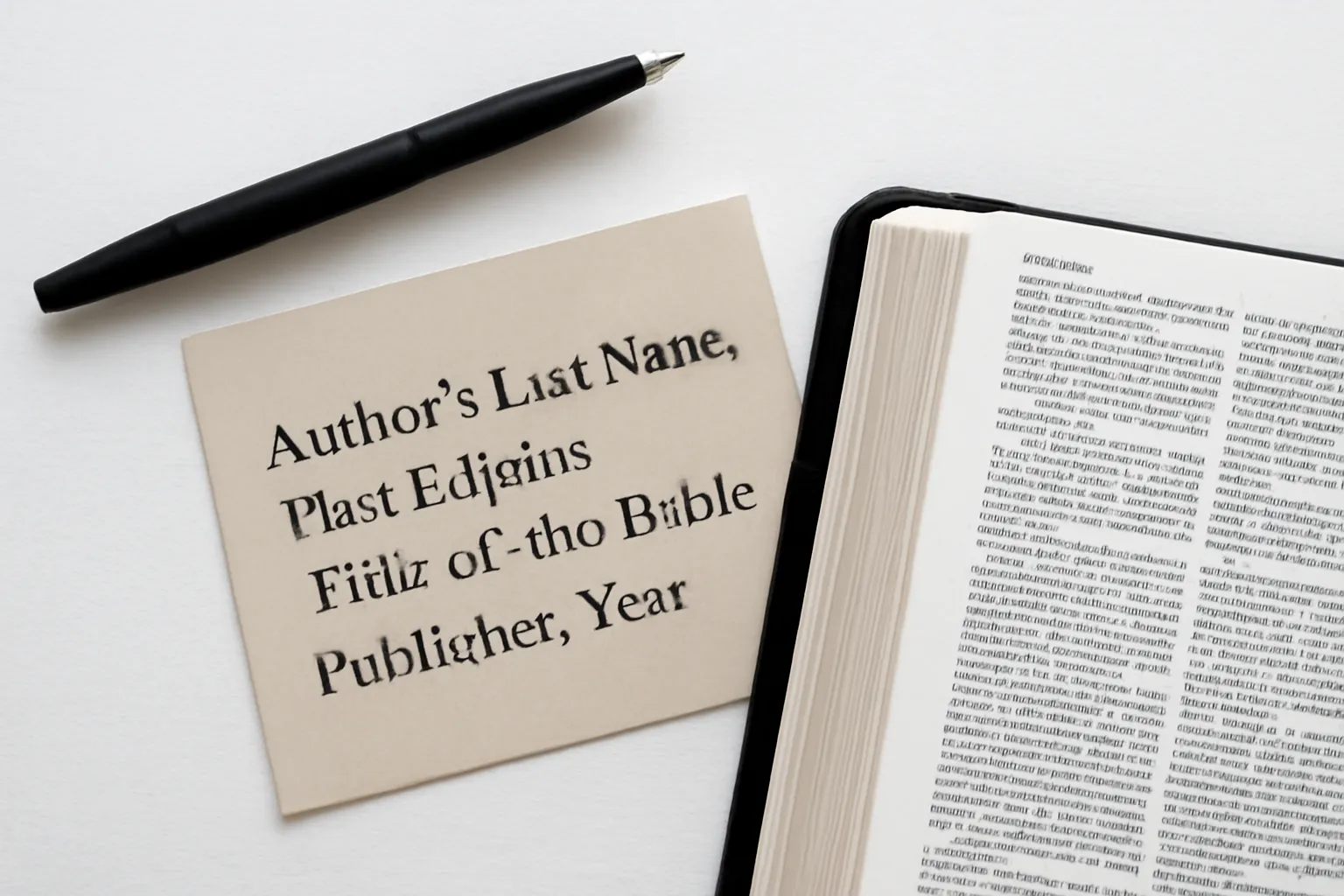
The Bible.Version/Edition Name, Editor(s)/Translator(s), Publisher, Year.
Examples of print editions
The Bible. King James Version, edited by King James III, Oxford University Press, 1611; updated edition, Oxford World’s Classics, 1998.
The Bible. New International Version (NIV), Zondervan, 2011.
The Bible. New Revised Standard Version (NRSV), Catholic Edition, Oxford UP, 1989.
Special formatting notes for works cited entries
When the edition has a named translator or editor, include that person after the edition name, separated by a comma.
If the Bible is part of a larger multi-volume work or a study edition with a subtitle, include the subtitle after the edition name.
If there are multiple editors or translators, you may list the principal editor or translator followed by others as appropriate.
Variants: citing other biblical texts within an edition
If you cite a specific book within a Bible edition that is hosted online, you can use in-text citations as usual
and refer to the edition in the Works Cited entry. For instance:
The Bible. NIV, Bible Gateway, 2011. Accessed 13 Mar. 2026.
Notes on page numbers
Unlike many print books, the Bible is typically cited by chapter and verse rather than page numbers. In MLA, you should
avoid relying on page numbers to locate passages. If a course or instructor requires page numbers for the Bible edition, you
should follow that guidance, but in standard MLA practice, chapter-and-verse citations are preferred.
Special Considerations: Translations, Deuterocanonical Books, and Online Texts
Citing different translations and editions
Translation matters because different translations reflect different source texts, wording, and verse numbering.
When citing the Bible in MLA, you should clearly indicate the version you used. If you mention the translation in your prose, you
can place the version name in the sentence and still provide a standard parenthetical citation. If you do not mention the version in the
sentence, include it in the Works Cited entry.
Citing the Deuterocanonical/Tobit/Writings and other non-Protestant books
Some Bible editions include deuterocanonical books or apocryphal texts. In MLA, you treat these just like other biblical
books, using the standard book abbreviations (for example, 1 Macc., Tob., Wis.) in
your in-text citations. The Works Cited entry for the edition will reflect the edition’s treatment of these books.
Citing online Bible texts and apps
For online or app-based Bibles, MLA guidance emphasizes identifying the edition or translation, the platform or website,
and the date of access. A typical online citation includes the following elements in this order:
The most important rule is consistency: pick a format for your in-text citations and your Works Cited entries and use it
for all biblical references in the document. If you switch formats, the entire reader audience may become confused. Choose
a single approach, explain any necessary deviations in a short note, and apply it uniformly.
Practical Examples and Templates
Example 1: In-text citation from a print edition
If you cite a passage from a print edition of the Bible and you are not explicitly mentioning the edition in your prose, you would commonly present:
“In Gen. 1.1, the creation narrative begins with light” (Gen. 1.1).
Example 2: In-text citation with the book named in the sentence
When you name the book in your sentence, you may place the verse range in the parenthetical:
The Genesis creation narrative begins with light (1.1).
Example 3: Works Cited entry for a print Bible edition
The Bible. New International Version, Zondervan, 2011.
Example 4: Works Cited entry for an online edition
If you are citing a study edition or a Bible with notes, you might format the entry as:
The Bible.NIV Study Bible, edited by John Doe, Zondervan, 2015.
Templates you can adapt
Book abbreviations + chapter.verse in-text: (Gen. 1.1)
In the Works Cited entry, include edition, editor/translator, and publication information: The Bible. NIV. Bible Gateway, 2011.
Common Pitfalls: What to Avoid in MLA Bible Citations
Using page numbers as the primary locator for passages. The Bible is typically cited by chapter and verse, not page numbers.
Omitting edition information in the Works Cited entry. Always identify the exact edition you used.
Inconsistent notation between in-text citations and Works Cited entries. Choose a format and stick with it.
Ambiguity about the translation. If you switch translations mid-paper, clearly indicate the version and provide separate citations as needed.
Additional Resources for Bible Citation MLA
MLA Handbook (9th edition): The primary reference for formatting and citation rules.
Purdue Online Writing Lab (OWL) MLA style guide: MLA Formatting and Style Guide with a section on biblical citations and religious works.
University writing guides and library guides that discuss MLA citation for the Bible and how to cite different translations.
Mastering Bible Citation MLA for Clarity and Credibility
Citing the Bible in MLA style is a skill that blends standard MLA conventions with the distinctive features of biblical texts:
the use of chapter-and-verse notation, the need to specify the edition or translation, and the
practice of using in-text citations that are precise and easily traceable in the Works Cited list. By following
the guidelines outlined in this article, you can produce clear, consistent, and reliable citations in essays, research papers, and
scholarly articles. Whether you refer to the King James Version, the NIV, or the NRSV, the key
is to document the exact edition you used and to format both in-text references and bibliographic entries according to MLA’s rules.
Remember: the aim of bible citation mla is not merely to satisfy a formatting checklist but to enable readers to locate
passages with confidence. When you present a well-structured citation, you demonstrate scholarly rigor and respect for the source material.