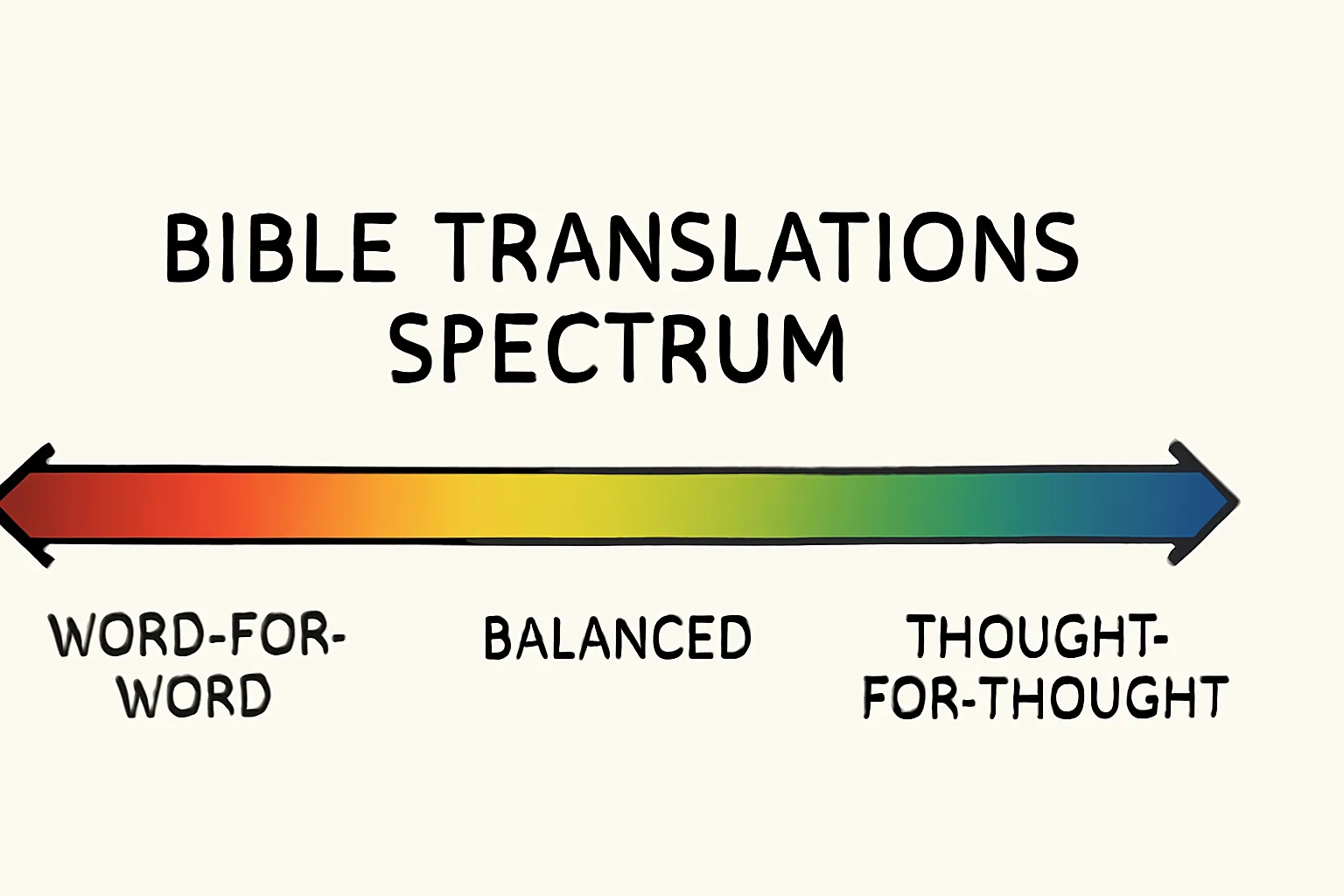
The Bible has been translated into thousands of languages, and in the process a rich spectrum of translations has emerged. This spectrum ranges from very literal renderings that seek to mirror line-by-line wording to highly accessible paraphrases that aim to convey meaning and tone in contemporary language. Understanding this translation spectrum helps readers choose the right version for study, devotion, teaching, or public reading, and it clarifies why different Bible versions exist side by side in libraries and on digital platforms.
The bible translations spectrum can be thought of as a continuum with several key positions along which a translator or a translation committee might align. Three primary categories are commonly discussed in scholarly and lay discussions:
Formal equivalence (word-for-word) — the aim is to reproduce the wording and grammatical structure of the original language as closely as possible, within the bounds of natural English. This approach prioritizes accuracy to the source text, sometimes at the expense of readability in contemporary English.
Functional equivalence (dynamic equivalence) — the aim is to convey the meaning of the original text in natural, readable English, even if the wording diverges from a literal rendering. This approach prioritizes clarity and accessibility for modern readers.
Paraphrase — the aim is to render the text in highly accessible, contemporary language, often rephrasing whole sentences or passages to capture ideas, rhythms, and impact rather than the exact wording or structure of the source.
Beyond the basic triad, translations can also be described in terms of their audience and purpose. Some are designed for rigorous study with extensive footnotes and apparatus, while others are designed for devotional reading, public worship, or teaching children. The range of Bible versions available reflects the diverse needs of readers—from scholars and students to pastors and laypeople.
Historical Overview: From Ancient Texts to Modern Translations
To understand the modern translation spectrum, it helps to situate it within a broader history of how the biblical texts were transmitted and rendered into other languages.
Early translations and textual foundations
Septuagint (LXX) — the Greek translation of the Hebrew Bible, produced in the last centuries BCE, which became a foundational text for the Greek-speaking world and for many early Christian communities.
Samaritan Pentateuch and other ancient witnesses — provide alternative textual traditions for the Pentateuch that influence some modern translations and notes.
Latin Vulgate — Jerome’s late-4th-century translation became the standard for Western Christianity for well over a millennium and shaped many later Latin, and Romance-language translations.
Other languages and traditions contributed variant texts, including Syriac, Coptic, Ethiopic, and later medieval vernaculars, each with its own translation history and impact on later English and European translations.
Reformation to early modern translations
John Wycliffe and William Tyndale and their followers played pivotal roles in bringing English readers closer to the biblical text in the vernacular, emphasizing accessibility and availability.
Douay-Rheims and other Catholic translations preserved Latin textual traditions while providing English renderings for Catholic readers.
The King James Version (KJV) (1611) became one of the most influential English translations ever, shaping English-speaking Christianity for centuries and setting a high standard for literary English in translation.
Modern era: a proliferation of translations and tools
In the 20th and 21st centuries, translators began to balance textual criticism with readership needs, incorporating new manuscript discoveries and updated critical editions to produce clearer, more accurate renderings in contemporary English.
Critical editions of the Greek New Testament (for example, Nestle-Aland/Ni text and UBS editions) and the Hebrew Bible (with Masoretic texts and textual notes) informed many modern translations.
Today’s Bible market features a rich array of translations, including formal equivalents, dynamic equivalents, and paraphrases, with study Bibles, interlinears, and digital tools enhancing accessibility and understanding.
Textual Foundations: What Underpins Modern Translations
Translations do not arise from a vacuum. They are built on a body of manuscripts and critical editions that aim to reconstruct the most plausible original wording. The choices translators make in this process strongly influence how a translation reads and how it is used in practice.
Old Testament foundations include the Hebrew Masoretic Text as the primary basis for most modern OT translations, supplemented by ancient versions and manuscripts such as the Septuagint (Greek translation) and the Dead Sea Scrolls, which sometimes preserve readings that differ from the MT.
New Testament foundations rely on a vast manuscript tradition of Greek texts. Modern translators consult critical editions such as Nestle-Aland (NA28) and the United Bible Societies 5th edition (UBS5), among others, to determine the most reliable wording.
Textual criticism is the scholarly discipline that weighs manuscript evidence, attempts to identify scribal errors, and evaluates potential emendations to approach the earliest attainable text.
Notes, introductions, and apparatus in many Bibles document variant readings, explain translation choices, and offer readers the opportunity to assess alternatives for themselves.
Scholars and readers often categorize translations into families based on their translation philosophy and approach. Here are the main groups you’ll encounter in the market and in scholarly discussion.
Formal Equivalence (Word-for-Word) Family
Translations in this group strive to preserve original word order, syntax, and precise terms as much as feasible. They are particularly valued for serious study, exegesis, and comparisons across passages. Examples include:
New American Standard Bible (NASB) — renowned for its literal approach and faithfulness to the source texts, with a commitment to precise wording and structure.
English Standard Version (ESV) — balances readability with formal precision, preserving literary cadence while maintaining close ties to the original languages.
King James Version (KJV) and New King James Version (NKJV) — classical renderings with enduring literary quality; NKJV updates archaic language while remaining close to the traditional Vorlage.
Revised Standard Version (RSV) and successors
Dynamic Equivalence (Thought-for-Thought) Family
This group seeks to communicate the sense and meaning of the original text in natural, contemporary English, sometimes rephrasing sentences to fit modern idiom and expectations.
New International Version (NIV) — long one of the most widely used translations for broad audiences; emphasizes readability and comprehension of the text’s meaning.
New Revised Standard Version (NRSV) — widely used in academia and churches; often chosen for its inclusive language and scholarly apparatus while maintaining readability.
New International Reader’s Version (NIrV) — designed for younger readers while maintaining conceptual fidelity to the original texts.
New Living Translation (NLT) — focused on clear, contemporary English; very accessible for devotional reading.
Paraphrase and Reading Translations
Paraphrase translations aim for maximum accessibility, capturing the spirit and impact of the text rather than its exact wording. They are not ideal for precise exegesis but are excellent for introductory reading, devotional use, or outreach contexts.
The Message (MSG) — highly idiomatic and contemporary; designed to convey the text’s feel and flow in modern speech.
The Living Bible (TLB) — an early paraphrase that offers readability and narrative flow.
The Voice — a modern paraphrase with additional interpretive essays and stylistic features to aid comprehension.
Study Bibles, Interlinear Editions, and Complementary Tools
These resources do not fall neatly into one translation philosophy; instead, they provide data, notes, and parallel texts to support in-depth study and cross-checking.
Interlinear Bibles present the original Hebrew or Greek text aligned with a direct English rendering, facilitating word-level study and lexical analysis.
Study Bibles (like the ESV Study Bible, NIV Study Bible, CSB Study Bible) couple translation with notes, maps, timelines, and articles.
Textual note editions include apparatus and commentary that discuss textual variants and interpretive choices.
Catholic, Orthodox, and Apocryphal-Influenced Translations
Some traditions maintain the deuterocanonical books and employ translation choices that reflect their canons and theological emphases.
New American Bible (NAB/NABRE) — widely used in Catholic liturgy in English; includes the deutero-canonical books.
Douay-Rheims (DR) — classic Catholic English translation with a distinct, traditional flavor.
Jerusalem Bible (JB) and New Jerusalem Bible (NJB) — Catholic translations with notes and literary style.
JPS Tanakh (Jewish Publication Society) — a respected English translation of the Hebrew Bible with Jewish scholarly emphasis.
Popular Bible Versions and What They Bring to the Table
Below is a concise guide to some of the most widely used translations, with notes on their philosophy, typical uses, and strengths. This is not an exhaustive catalog, but a practical overview to help you navigate the Bible translations spectrum.
The King James Version (KJV) and the New King James Version (NKJV)
KJV — classic, majestic, and culturally influential; based on late medieval manuscripts and the Textus Receptus for the New Testament; celebrated for literary quality, memorability, and historical impact. Best for readers who value tradition, literary beauty, and historical connection to English-speaking Christianity.
NKJV — updates archaic language while preserving the traditional verse structure and cadence of the KJV; useful for readers who want familiarity with the KJV but prefer modern spelling and punctuation.
New American Standard Bible (NASB) and English Standard Version (ESV)
NASB — widely recognized for its formal equivalence approach; precise, heavily footnoted, and favored in systematic study and exegesis.
ESV — a popular middle ground balancing formal accuracy with readable English; highly favored for preaching, study, and scholarship that appreciates contemporary readability without sacrificing precision.
New International Version (NIV) and New Revised Standard Version (NRSV)
NIV — one of the most widely used English translations globally; engages a broad audience with clear and natural English while retaining fidelity to the original texts.
NRSV — a standard in many seminaries and churches; known for inclusive language, scholarly rigor, and suitability for academic use.
New Living Translation (NLT) and The Message (MSG)
NLT — emphasizes fluent, readable English and contemporary phrasing; excellent for personal devotions and casual reading, while still conveying the sense of the original texts.
The Message — a highly paraphrastic rendition that aims to capture the tone and conversational feel; best for readers seeking a fresh, interpretive read rather than precise wording.
Dynamic Equivalence with Study Support
NET Bible — renowned for its extensive translator notes and access to the original languages; combines accessible English with thorough scholarly apparatus.
CSB (Christian Standard Bible) — a balanced modern translation that aims for readability and precise wording, designed to be both accurate and approachable for a wide audience.
Specialized and Catholic Traditions
NABRE/NAB — standard Catholic English translation with updated language and extensive notes; used in liturgy and study.
Douay-Rheims — retains a traditional Catholic flavor, valued by some readers for its historical connection to early English Catholic scholarship.
JPS Tanakh — key English translation for Jewish readers, with scholarly notes and a strong emphasis on the Hebrew text.
Choosing the Right Translation for Contexts
Different contexts call for different translations. Here are practical guidelines to help you select the most suitable version for your needs:
For rigorous study and precise exegesis — consider NASB, ESV, or RSV as primary options; use an edition with robust study notes and a reliable textual apparatus.
For broad reading, devotional use, and public worship — NIV, NRSV (in inclusive contexts), or NLT often provide natural phrasing and readability without sacrificing core meaning.
For memorization or traditional worship — KJV (for cadence and historic resonance) or NKJV (for readability while preserving KJV cadence).
For bilingual study or academic work — interlinear editions and NET Bible notes are particularly helpful, as are parallel-text editions that present multiple translations side by side.
For Catholic readers or those studying canonical variations — NABRE or Douay-Rheims, paired with a good study Bible that explains deutero-canonical books.
For children or new readers — consider reader-friendly translations such as the NIrV or straightforward paraphrases with caution about relying solely on paraphrase for doctrinal precision.
The Translation Process: How a Bible Version Comes to Be
Creating a new Bible translation is a multi-year endeavor involving a team of scholars, linguists, theologians, and editors. Here are the essential steps typically involved:
Textual selection — editors determine the base Hebrew and Greek texts to use as the foundation (e.g., MT for the Old Testament, NA28/UBS5 for the New Testament).
Philosophical alignment — committees decide on a translation philosophy: formal, dynamic, or paraphrase, and how much weight to give to textual notes and historical context.
Translation work — translators render the text into the target language, balancing fidelity to the source with readability in the target language.
Review and revision — drafts undergo multiple rounds of scrutiny, including linguistic review, theological review, and proofreading.
Notes and apparatus — Many editions include translator notes, textual variants, cross-references, and historical context to aid readers.
Publication and dissemination — the final product is published in print and digital formats, often accompanied by study aids, maps, and concordances.
Challenges and Considerations in the Translation Spectrum
Readers should be aware of several ongoing considerations that influence how translations are produced and received:
Manuscript availability — new discoveries or reevaluations of ancient manuscripts can shift translation choices, especially for passages with contested wording.
Language evolution — English usage evolves; translators must decide whether to preserve archaic forms or adopt current usage to maintain comprehension.
Gender and inclusive language — some modern translations adopt gender-inclusive language in appropriate contexts, which can be controversial and varies by denomination and audience.
Doctrinal nuance — translators must navigate doctrinal nuance and theological commitments without allowing confessional bias to distort translation choices
Accessibility and audience — publishers tailor translations to audiences, from scholarly readers to children to non-native English speakers, which influences vocabulary and syntax choices.
Practical Tips for Using the Bible Translation Spectrum
Whether you are a student, pastor, or curious reader, these practical tips can help you navigate the spectrum effectively:
Cross-check important passages — read a key verse in multiple translations to see how different philosophies affect translation choices.
Use study aids — consult study Bibles, commentaries, and textual notes to understand underlying manuscripts and why translators chose certain renderings.
Match the task to the translation — for in-depth analysis of language and syntax, prefer formal equivalents; for daily devotion and accessibility, prefer dynamic equivalents or paraphrases as a complement to study.
Consider parallel Bibles — many editions present multiple translations side-by-side to facilitate comparison and deeper understanding.
Respect context — some passages require careful attention to historical and cultural context; a more literal translation may illuminate underlying nuances that paraphrases gloss over.
How the Translation Spectrum Shapes Bible Engagement
The spectrum is not merely an academic taxonomy; it shapes how people encounter Scripture in worship, education, and personal life. A reader who chooses a literal translation for a study session may notice subtle nuances in word choice, which can lead to fruitful exegetical work and scholarly discussion. A reader who chooses a readable dynamic translation for daily reading may experience greater engagement and personal application, as ideas and stories feel immediacy and relevance. A reader who uses a paraphrase as an entry point may gain familiarity and curiosity, which can then be deepened by cross-checking with more literal texts.
Common Misconceptions About Bible Translations
As readers explore the spectrum, a few myths persist. Clarifying these can help prevent confusion and misapplication:
All translations are equally accurate — in practice, different translation philosophies emphasize different aspects of accuracy (word-for-word vs sense-for-sense) and can yield different renderings for the same verse. Reading multiple translations can help triangulate meaning.
Paraphrases are “bad” or unreliable — paraphrase translations serve a purpose, especially for outreach, introduction, or quick reading. They should not be used as the sole source for doctrinal study but can supplement more precise translations.
Modern translations are inferior to older ones — modern translations benefit from access to better manuscripts, improved language, and more sophisticated translation methods. They complement older translations rather than merely replace them.
One translation fits all situations — no single Bible version perfectly meets every need. A balanced approach often involves using multiple translations for different purposes.
Navigating the Bible Translations Spectrum with discernment
The bible translations spectrum is a reflection of centuries of linguistic skill, textual criticism, theological reflection, and pastoral care. From the Masoretic Text and Septuagint to modern critical editions and an array of English renderings, the Bible has been re-expressed in countless ways to be understood, believed, and practiced in diverse communities. By understanding the spectrum—the aims of formal equivalence, dynamic equivalence, and paraphrase—readers can choose editions that best fit their current needs, whether they are studying the original languages, preparing a sermon, teaching a class, or seeking daily encouragement. The goal remains constant: to open the ancient text in ways that awaken understanding, faith, and transformation in contemporary life.
To begin or deepen your exploration, consider pairing a formal-equivalence translation for study with a dynamic-equivalence translation for devotional reading, and use study Bibles or interlinear editions to gain insights into language and manuscript history. As you move through these options, you will likely discover that the fusion of history, language, and purpose in the Bible translations spectrum offers not just words on a page, but pathways to meaning, faith, and life.
Bible Translations History: A Quick Overview The story of Bible translations is a long, living thread that runs from the first scrolls in ancient languages to today’s global digital texts. It is a history of languages, communities, theology, and technology all working together to make sacred writings accessible across cultures and centuries. In broad terms,…