The story of Bible translations is a long, living thread that runs from the first scrolls in ancient languages to today’s global digital texts. It is a history of languages, communities, theology, and technology all working together to make sacred writings accessible across cultures and centuries. In broad terms, the translation history of the Bible traces how a collection of Hebrew, Aramaic, and Greek texts was gradually rendered into many other tongues, often in conversation with competing manuscript traditions, ecclesial authorities, and evolving methods of translation. This article surveys that journey, highlighting key moments, turning points, and enduring tensions that continue to shape the way people read the Bible today.
The phrase bible translations history can be explored through several lenses: textual criticism (the effort to reconstruct the most probable original wording), linguistic transfer (the act of rendering from one language into another), and reception history (how readers in different eras and communities understand and use the text). Throughout the centuries, translators faced questions such as which source texts to rely on, how literal to be versus how readable, and how to balance doctrinal fidelity with linguistic clarity. While the methods and motivations vary, the aim has remained largely the same: to translate sacred words into the vernacular so that believers can read, hear, and meditate on Scripture in their own language and life situation.
Origins and Old Testament Foundations: Hebrew, Aramaic, and the Septuagint
The earliest components of Bible translation began not with formal translations but with the exposure of communities to sacred texts in their original languages. The Hebrew Bible (Tanakh) was written primarily in Biblical Hebrew, with portions in Aramaic. Jewish communities preserved these texts through meticulous copying and scribal tradition. In many ways, the survival of the Hebrew Bible depended on a living culture of reading, teaching, and ritual use within synagogues and study houses.
One of the first monumental translation efforts was the Septuagint (LXX), a Greek translation of large portions of the Hebrew Scriptures produced in the Hellenistic period, traditionally dated to the last centuries BCE. The Septuagint served several crucial functions:
It opened the Hebrew Scriptures to Greek-speaking Jews who no longer understood Hebrew well.
It became foundational for early Christians, many of whom read the Greek text in the Greek-speaking world.
It provided a record of how ancient interpreters understood the text in a different linguistic and cultural milieu.
In the centuries that followed, Jewish and Christian communities engaged with translations as living interpretive tools. Other early versions included translations into Syriac (the Peshitta), Latin, and Ge’ez, as well as various later Latin and translation practices within Christian communities that sought to preserve scripture’s authority across language groups. These early translation efforts laid the groundwork for how later generations would think about translation as interpretation and translation as accessibility.
Key dynamics in the ancient and late-antique period
Language shift: As peoples moved and the church spread, faithful communities increasingly required scriptures in their vernaculars or linguae francae.
Authority and tradition: The respect accorded to a text in a given language often followed the prestige of the community that used it (for example, Greek in the early Christian church, Latin in the Western church).
Textual variation: Divergence among Hebrew manuscripts, Greek MSS, and early translations created a dynamic environment in which accuracy and stylistic clarity competed for priority.
From Latin Dominance to Vernacular Inroads: The Latin Vulgate and Medieval Transmission
With the rise of the Latin Vulgate as a standard text in Western Christendom, translation activity moved from the margins toward centralized ecclesial authority. Commissioned by Pope Damasus I in the late 4th century and largely completed by Jerome, the Vulgate aimed to provide a single, consistent Latin text that could be used for liturgy and study across Western Europe. Its influence was profound for several reasons:
It served as the standard Bible for the Latin-speaking church for roughly a millennium.
It shaped Christian doctrine and theological vocabulary in the West, shaping how Scripture was read and preached.
It established a framework for textual standardization, even as manuscript copies proliferated with regional variations.
Translation in the medieval period did not vanish; rather, it expanded in different directions. Monasteries, cathedral schools, and later universities began producing paraphrastic and scholastic commentary-laden editions in Latin and vernaculars in parallel with liturgical use. In many cases, vernacular Bible portions existed in manuscript form, but access remained uneven, and formal Bible study was typically mediated by clergy and educated elites.
From a modern perspective, the medieval era can be seen as a long apprenticeship in which the church refined its sense of translation fidelity, textual authority, and the tension between public worship and private reading.
Renaissance, Humanism, and the Birth of Modern Bible Translation
The Renaissance brought a renewed interest in original languages, textual criticism, and the potential for translations that brought the Scriptures into the common languages of European readers. A few landmark moments defined this era:
Desire to recover original texts: Scholars like Desiderius Erasmus published a widely used Greek New Testament (1516), accompanied by innovative Latin and vernacular editions. His work helped shift the focus from a sole reliance on the Latin Vulgate to the co-presence of Greek manuscripts as a source of textual precision.
Protestant reformers and vernacular Bibles: Reformers such as Martin Luther produced German translations (New Testament 1522; Bible 1534). Luther’s approach made the scriptures directly accessible to lay readers and encouraged a broader culture of biblical interpretation outside monastic and clerical spaces.
English vernacular pushes: In England and beyond, translators sought to democratize access to the Bible in the mother tongue. William Tyndale’s English New Testament (1525) and his ongoing revisions laid a groundwork that would influence many later English editions, even though his work faced severe opposition.
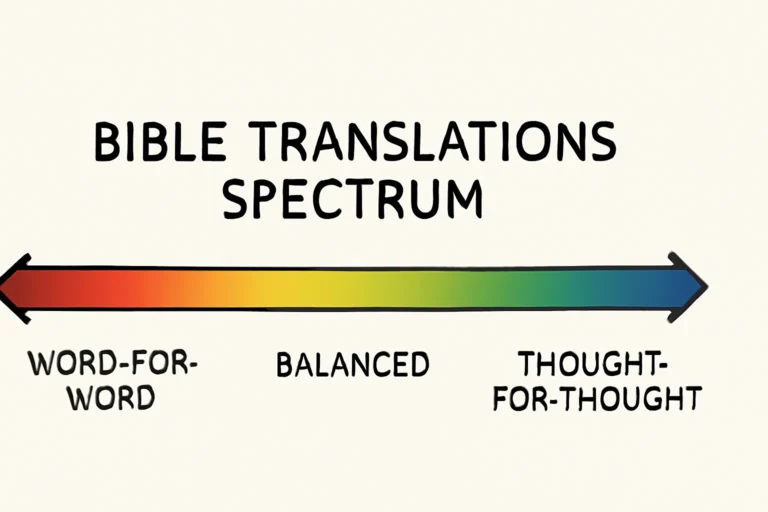
During this period, translation theory began to take shape in more explicit form. Translators faced a practical question: should a version strive for literal fidelity to the source texts (formal equivalence), or should it aim for readability and natural flow in the target language (dynamic or functional equivalence)? Both impulses coexisted and often competed within the same projects, producing a spectrum of translations rather than a single dominant approach.
English Bible Development: From Tyndale to the Authorized Version
The English Bible emerged through a series of important steps that culminated in one of history’s most influential translations, the King James Version (KJV), completed in 1611. Key milestones include:
Tyndale’s Bible (1525) translated from Hebrew and Greek sources, providing a model of accessible English and a translation style that would influence generations of English readers.
The Great Bible (1539), a mass-produced English Bible that helped establish a standard text for public use.
Geneva Bible (1560), popular in Protestant circles and notable for its marginal notes and translation decisions.
The Authorized Version or KJV (1611), which achieved broad ecclesial reception and became a standard in Protestant communities for centuries.
Translations in this era were not merely linguistic events; they represented cultural shifts that enabled new forms of reading, sermonizing, and personal devotion. The KJV, in particular, became a literary standard whose cadence and diction shaped English-speaking religious life for generations, while also inviting ongoing revision and re-evaluation as printed texts spread and scholarship advanced.
Catholic and Orthodox Traditions: Latin, vernacular, and beyond
Within the Catholic tradition, the Catholic Church maintained a strong reliance on the Latin text for liturgy and doctrinal formation, while also developing sanctioned vernacular translations for the faithful. The Douay-Rheims (1609–1610 in parts; later revisions) is a notable Catholic English translation based on the Latin Vulgate and aimed at providing an English counterpart to the Latin liturgical experience. Other developments include:
The Clementine Vulgate (1592), the official Latin edition for centuries until more recent revisions.
Later Catholic translations into English and other languages that emphasized ecclesial authority and the deuterocanonical books, often with different orderings and textual emphasis than Protestant canons.
In the Eastern Christian world, Orthodox translations and versions in Church Slavonic, Greek, Armenian, and other languages have their own trajectories. These translations often maintain a liturgical rhythm and interpretive tradition distinct from Western denominations, emphasizing continuity with patristic reading and liturgical use.
19th and 20th Century: Critical Texts, Revisions, and Global Expansion
As textual criticism matured as a scholarly discipline, Bible translation entered a new era characterized by more critical editions, broader language coverage, and a growing concern for accuracy across manuscript traditions. Some defining developments include:
Critical editions of the Greek New Testament and the Hebrew Bible, such as the Westcott-Hort and later the Nestle-Aland/UBS text, which sought to reconstruct the most probable original wording.
New English translations that varied in philosophy, from formal equivalence to dynamic equivalence, reflecting debates about readability versus fidelity.
Major English translations of the 20th century, including the Revised Standard Version (RSV, 1952; 1966 updated), the New American Standard Bible (NASB, 1971), and the New International Version (NIV, 1978; updated subsequently).
In addition to English, the 19th and 20th centuries witnessed a remarkable expansion of Bible translation into many world languages. Missionary efforts, colonial-era language work, academic linguistics, and societies dedicated to scripture translation created a multilingual ecosystem in which thousands of languages gained access to portions or the full Bible. This period also saw a growing recognition of translation ethics, including respect for cultural idioms, religious sensibilities, and the needs of minority language communities.
Textual methods and translation philosophies
Two dominant philosophies have guided modern translation work, though most projects mix approaches:
Formal equivalence (word-for-word): prioritizes a close rendering of the grammatical structure and vocabulary of the source text. Examples commonly associated with this approach include the NASB and ESV.
Dynamic (functional) equivalence (thought-for-thought): prioritizes readability and natural expression in the target language, even if it means departing from a strict local word-for-word rendering. Examples include the NIV and other translations oriented toward contemporary readers.
Translation committees often blend these approaches to balance fidelity with clarity, cultural resonance, and theological integrity. A central challenge is deciding how to render terms with rich theological nuance (for example, terms like salvation, righteousness, and kingdom) so that readers encounter a faithful sense of the original ideas without losing idiomatic meaning.
Late 20th Century to Digital Era: Accessibility, Diversity, and Technology
As printing costs declined and digital technology grew, Bible translations became more accessible than ever. Key trends include:
Global Bible distribution through print, audio, and, later, digital formats, bringing Scripture to remote areas and diverse communities.
Public-domain and licensed translations that could be embedded in software, websites, and apps, broadening distribution and use in education, ministry, and personal devotion.
Interconfessional and ecumenical projects that sought to produce translations acceptable to a range of church traditions, strengthening cross-denominational study and dialogue.
Translations for modern readers often come with added resources such as cross-references, study notes, and guides to textual criticism. The rise of online Bibles, mobile apps, and translation databases has transformed how scholars and lay readers interact with the Bible, enabling features like searchability, parallel translations, and access to manuscripts and scholarly apparatus.
Source Texts, Canons, and Debates: What Lies Behind Translations
One of the most persistent debates in Bible translation concerns which source texts to use and how their own textual histories should influence translations. Some of the major issues include:
Masoretic Text vs. Septuagint in Old Testament translation: Some English translations rely primarily on the Masoretic Hebrew text, while others incorporate readings from the Septuagint, sometimes with notes explaining variations.
Deuterocanonical books and their canonicity: Catholic and Orthodox canons include books that Protestant Bibles typically place in a separate section or do not include at all. This difference shapes translation choices and the presentation of those books.
Textual criticism and variant readings: The presence of variant readings in ancient manuscripts leads translators to choose among options, often with notes about textual uncertainty.
These debates are not purely academic. They influence the kinds of questions readers ask about Scripture, the language that shapes theological vocabulary, and the way communities understand core doctrines. Readers should know that a translation is an interpretation shaped by textual choices, doctrinal commitments, and audience needs as much as by linguistic equivalence.
Modern Trends: Accessibility, Inclusivity, and the Future of Bible Translation
Today’s Bible translation landscape is characterized by:
Inclusivity in language: Many newer translations strive to render gender-neutral or gender-inclusive language where Scripture indicates inclusive meaning, while preserving fidelity to the original text’s intent and cultural context.
Plural forms and coastal cultures: Translations increasingly consider regional dialects, colonial histories, and local idioms to ensure broad intelligibility without sacrificing doctrinal nuance.
Digital tools: Online platforms, machine-readable texts, and translation databases support scholarly collaboration, crowd-sourced improvements, and rapid revision cycles.
Ecumenical cooperation: Translation committees often bring together scholars from different Christian traditions to craft texts with broad acceptance and usefulness for shared study and worship.
As the audience for Bible translations grows across languages and cultures, the conversation about translation ethics, translation quality, and reader accessibility continues to evolve. The result is a diverse ecosystem of translations—from tightly literal texts used in study to highly readable versions designed for daily devotion and public preaching.
Impact, Reception, and How to Read a Translation
Translations matter not only for where and how people read the Bible, but also for how communities interpret Scripture and practice faith. Readers should consider a few practical guidelines when engaging with translations:
Check multiple translations: Reading parallel versions can illuminate how different translators handle difficult passages and key terms.
Consult notes and introductions: Translation introductions, textual notes, and articles on methodology help readers understand the approach and limits of a given edition.
Be mindful of canon and tradition: Some translations reflect the canons and theological priorities of particular church bodies; knowing this context can enhance interpretation without disparaging other traditions.
Engage with original languages when possible: Basic knowledge of Hebrew and Greek, or access to reliable lexica and grammars, can deepen understanding beyond English renderings.
In practice, readers who approach the Bible through translation enter a continuum of listening and interpretation. A translation is a bridge, not a retrieval of a perfect original. It carries the voice of its translators, the expectations of its readers, and the living memory of the communities that preserved and shared the text across time.
Important Landmarks in the History of Bible Translations
To distill the broad arc of the bible translations history into memorable landmarks, consider the following milestones, which illuminate the evolution from scriptural transmission to global accessibility:
Septuagint’s emergence as a Greek bridge for Hebrew scriptures in the ancient Diaspora.
Jerome’s Vulgate consolidating a canonical Latin text that would shape Western Christianity for centuries.
Renaissance Greek and Hebrew projects that revived original-language study and promoted vernacular translations.
Tyndale’s English New Testament and the broader effort to place Scripture in the language of lay readers.
King James Version and its enduring influence on English-speaking Christianity and world literature.
20th-century critical editions and modern translations reflecting advances in linguistic theory and manuscript discovery.
Digital and global expansion enabling broad, rapid, and diverse access to Scripture in hundreds of languages.
Each milestone marks a shift in practice, audience, and purpose. Taken together, they reveal a story of translation as mission, translation as scholarship, and translation as cultural negotiation.
Glossary of Key Terms
To help navigate discussions about Bible translation history, here is a brief glossary of terms you may encounter:
Masoretic Text: The authoritative Hebrew text of the Jewish Bible, standardized by Jewish scribes in the medieval period.
Septuagint (LXX): The ancient Greek translation of the Hebrew Bible, influential in both Jewish and Christian traditions.
Vulgate: Jerome’s Latin translation of the Bible, which became the standard Latin text for Western Christianity.
Textual criticism: The scholarly practice of comparing manuscript evidence to determine the most probable original wording.
Formal equivalence (word-for-word translation): A translation approach aiming for close fidelity to structure and wording.
Dynamic equivalence (thought-for-thought): A translation approach prioritizing natural readability and meaning in the target language.
Deuterocanonical books: Books included in Catholic and Orthodox canons but often excluded or placed differently in Protestant canons.
A Living Tradition of Access and Growth
The history of Bible translations is not merely a sequence of editions; it is a living, evolving practice that reflects the desires of communities to know Scripture in their own language and context. From the early spread of Greek and Latin translations to the modern era of dozens of living languages and digital formats, the bible translations history reveals a sustained commitment to making sacred texts intelligible, meaningful, and usable across cultures and generations. While the texts themselves are ancient, the act of translation remains contemporary—shaped by linguistic discovery, technological innovation, and the ongoing need to hear the biblical message in the languages and voices of today.
As readers, scholars, and faith communities continue to navigate the complexities of source texts, canons, and translation philosophy, the story of Bible translations will surely keep evolving. The core aim endures: to invite people to read, reflect, and respond to the biblical witness in ways that illuminate faith, foster understanding, and cultivate wisdom across the diverse tapestry of human language and life.
The Bible has been translated into thousands of languages, and in the process a rich spectrum of translations has emerged. This spectrum ranges from very literal renderings that seek to mirror line-by-line wording to highly accessible paraphrases that aim to convey meaning and tone in contemporary language. Understanding this translation spectrum helps readers choose the…