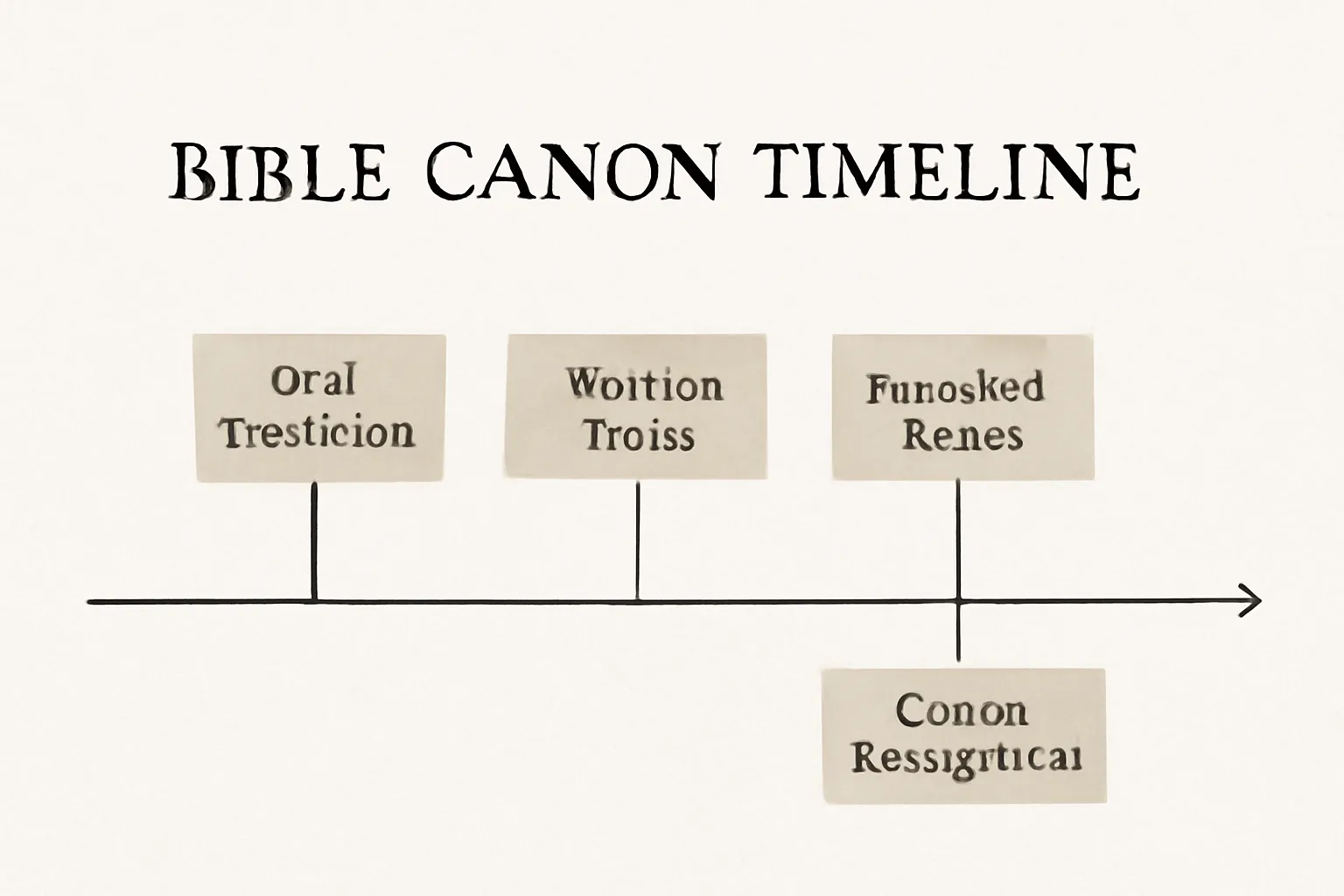
The phrase bible canon timeline invites us to trace how
certain books came to be regarded as authoritative within different
religious communities. Across centuries, communities wrestled with questions
about authorship, inspiration, historical reliability, and theological
coherence. The result is a layered story in which the Hebrew Bible
(also called the Tanakh in Jewish context) and the New Testament writings emerged, circulated, and finally
received broad recognition — though not without regional variations and
scholarly debate. In this article, we will explore the canon formation
timeline as a sequence of milestones rather than a single moment of
birth. The goal is not merely to date events but to illuminate how
communities defined the scope, authority, and permanence of the sacred
scriptures that shaped faith, worship, and teaching.
Throughout this discussion you will encounter several recurring phrases: canon formation, bible canon formation, canon development,
and canon formation timeline. Each term points to the same broad
process: a historically contingent journey from diverse writings to a
coherent collection recognized as authoritative for faith and practice.
Early Foundations: The Hebrew Bible and Its Formation
To understand the bible canon timeline, we begin with the
oldest component of the tradition: the Hebrew Bible. The Hebrew Bible
comprises three major sections—the Torah (Law), the Prophets, and the writings—and is often
referred to collectively as the Tanakh in Jewish circles.
The development of this corpus occurred over many generations, with a
process that gradually solidified a recognizable canon by late antiquity.
Emergence of the Torah: The Core of the Covenant
The Torah — Genesis through Deuteronomy — is widely understood
as the earliest and most authoritative portion of the Hebrew Bible. It
comprises the foundational narratives, legal codes, and covenantal
expectations that shaped Israelite religion. The formation of Torah
literature likely began long before it was explicitly recognized as a fixed
collection. By the time rabbinic authorities began to speak of a closed
canon, the Torah was already treated as the core, non-negotiable text for
Jewish communities.
Prophets and Writings: Broadening the Canonic Scope
After the Torah, the Prophets (including former and latter
prophets) and the Writings expanded the canon with
historical narratives, prophetic oracles, poetry, wisdom literature, and
more. The process of recognizing these portions as canonical moved forward
as communities identified texts that consistently reflected God’s will,
prophetic authority, and theological coherence within the tradition.
The Septuagint and Its Impact on the Canon
The Greek translation of the Hebrew Scriptures, known as the Septuagint
(LXX), played a pivotal role in shaping both Jewish and Christian
understandings of the canon. As Greek-speaking Jewish communities grew in the
diaspora, the Septuagint became the standard Bible for many early
Christians. Its textual choices, including broader book boundaries and
additional passages, had long-lasting consequences for how a later
Christian canon would be formulated.
The LXX and the Diaspora
The Septuagint was more than a translation; it was a living
library that allowed Jews living outside of Israel to access their sacred
texts in a common tongue. The LXX included translations of the Torah and
substantial portions of the Prophets and Writings. In the first few centuries
CE, Christians inherited this larger collection and began to quote from it as
Scripture in their preaching and writings.
Deuterocanonical Books: A Key Point of Divergence
A central feature in the bible canon timeline is the set
commonly called the deuterocanonical books by Catholics or apocrypha by Protestants. These are books such as Tobit, Judith,
Wisdom, Sirach (Ecclesiasticus), Baruch, and 1–2 Maccabees, plus additions to
Daniel and Esther found in the Septuagint but not in the later Masoretic
Text. The status of these writings became a flashpoint in the centuries that
followed, influencing how different communities defined the scope of the
canon and, in turn, how they understood authority and tradition.
Intertestamental and Early Christian Context
The period between the close of the Hebrew Bible’s canonical circle and the
formalization of the New Testament canon was marked by lively use and
debate over which writings should count as authoritative. Early Christians did
not begin with a fixed New Testament in the same way that the Hebrew Bible
had become settled; instead, they relied on a growing collection of
writings that claimed apostolic authority or strong connection to the
apostolic circle.
Early Christian Use and Authority
Early Christian communities quoted and circulated letters and gospels
attributed to apostles. The question was not only whether a text claimed
inspiration but also whether it aligned with the apostolic witness and with
the already established scriptures. The process involved a careful balance
between receiving new writings as authoritative and maintaining fidelity to
what communities already recognized as sacred scripture.
The Marcion Controversy
In the mid-2nd century, the prominent Christian teacher Marcion
proposed a radical canon that included only a modified Luke-Acts and ten
Pauline epistles, effectively excluding the Hebrew Bible from Christian
worship. The response to Marcion highlighted two crucial issues: (1) the need
to articulate a broader Christian canon that reflected apostolic teaching, and
(2) the desire to preserve continuity with the Hebrew Scriptures. This
controversy spurred church leaders to clarify the status of the canonical
writings and to establish a more inclusive sense of what could be
considered scripture for Christians.
The Muratorian Fragment
The Muratorian Fragment (roughly late 2nd century) is one of
the earliest surviving lists of authoritative New Testament writings. While not
a definitive canon, this document demonstrates that communities in the early
church were already cataloging a core set of writings (including the Gospels,
Acts, letters of Paul, and some other apostolic writings) and distinguishing
these from non-canonical documents. It serves as a valuable snapshot of
how early Christians began to articulate a boundary around the New Testament.
Formation of the New Testament Canon: Milestones in Canonical Closure
The bible canon timeline for the New Testament culminates in a
series of recognitions and endorsements across different geographical centers
of Christianity. By the fourth century, many Christian communities agreed on a
core corpus, though some variations persisted for a time. The process
involved patristic writings, ecclesial practices, and formal declarations in
councils that helped stabilize the New Testament canon in broadly shared form.
Early Lists and Criteria
Early lists typically relied on several criteria: apostolic authorship or
close association with an apostle, consistent use in liturgy and teaching,
theological conformity, and universal acceptance by Christian communities. Over
time, these criteria helped differentiate between texts that would be read in
worship and those that would be considered valuable for other purposes.
Influential Fathers and Figures
Fathers of the church such as Athanasius, Irenaeus,
and Eusebius played important roles in shaping the discussion
about which writings deserved canonical status. Athanasius’s Festal Letter of 367
(often cited as a key data point) provided a list of books that closely matches
the later accepted New Testament canon in most traditions. This milestone helped
both Eastern and Western churches converge on a shared core.
The Role of Church Councils
The formalization of the New Testament canon is closely tied to councils and
regional synods that affirmed a stable collection. While there was no single
“canon council,” several key milestones include declarations and endorsements
from regional councils in the late 4th and early 5th centuries. These events
helped settle disputes about disputed writings and supported a unified
recognition across the church.
Councils and Fathers: The Final Consensus
The period between the 4th and 5th centuries represents a watershed in the
canon timeline. Decisions made in this era shaped the boundaries of the New
Testament and the broader canonical framework for Christian scripture. The
convergence was not merely administrative; it reflected a deepening sense that
certain texts carried apostolic trust and could anchor doctrine, teaching, and
practice across diverse Christian communities.
Athanasius and Festal Letter 39
The Festal Letter 39 of Athanasius (circa
367 CE) is often cited as a decisive benchmark for the New Testament canon.
He listed a precise set of 27 books that correspond closely to the modern
New Testament in most Christian traditions. This document did not create the
canon from scratch, but it functioned as a compelling witness to a growing and
widely accepted collection that would be affirmed in subsequent decades.
Councils of Hippo and Carthage
The Council of Hippo (393 CE) and the Carthage
Councils (397 and 419 CE) contributed crucial regional affirmations.
They provided lists that included the same 27 New Testament books and clarified
the status of the Old Testament in the wider Christian context. These councils
also helped to settle questions about whether certain disputed or apocryphal
writings should be read as scriptural. In Western Christianity, these decisions
carried enormous weight and influenced subsequent Catholic and Protestant
understandings of scriptural authority.
Latin Vulgate and Jerome
The Latin Vulgate, translated largely by Jerome,
became the standard Latin translation of the Bible for Western Christianity.
Jerome’s work included his own judgments about the canonicity of various books
and played a pivotal role in transmitting a stable textual basis for the canon
in the Western church. While Jerome did not single-handedly determine the canon,
his translations and notes helped solidify the boundaries that undergirded
Catholic biblical interpretation for centuries.
Canonical Differences Across Traditions
One of the most important features of the bible canon timeline
is that different Christian and Jewish communities eventually settled on
slightly different canons. These divergences reflect historical, linguistic, and
theological developments, as well as communities’ uses of Scripture in worship
and teaching.
Catholic, Protestant, and Orthodox Canons
– The Catholic Old Testament includes the deuterocanonical books
in the canon as a regular part of Scripture, aligning with the broader Septuagint
tradition. In Catholic Bibles, these books are placed within their proper
sections and are treated as canonical.
– The Protestant canon follows the Hebrew Bible for the Old
Testament, excluding the deuterocanonical writings in most standard editions.
Protestant traditions often label these books as apocrypha,
recognizing their historical and spiritual value but not treating them as
canonical for doctrine.
– The Orthodox church traditions display variation across
national churches (e.g., Greek, Russian, Ethiopian, and Armenian traditions).
Some Orthodox canons include additional books or prayers in certain cases, such
as broader selections of books beyond the standard Catholic list. The precise
boundaries can differ, but the overarching theme is continuity with ancient
usage and liturgical tradition.
Deuterocanon vs. Apocrypha: Terminology and Purpose
The terms deuterocanonical and apocrypha reflect
perspectives on authority. In Catholic usage, “deuterocanonical” highlights
a secondary level of canonicity within the broader set of scriptures; in
Protestant usage, apocrypha signals texts that are valuable
historical and spiritual literature but not part of the official canon
used for doctrine. These terminological distinctions surface in the
ongoing study of the canon’s formation timeline and its reception in
different communities.
The Canon’s Influence on Worship, Translation, and Theology
The canon timeline is not only a matter of historical dates; it shapes how
communities worship, translate, and interpret sacred texts. When a group
recognizes a book as canonical, that status affects:
Liturgy: readings in congregational worship often align with
the accepted canon, guiding what is proclaimed, preached, and sung.
Translation: translators must decide how to handle books
and portions with disputed status, or how to render language that depends on
canonical context.
Doctrinal Formulation: canonical status can influence
theological formulations, creeds, and confessional statements.
Throughout the evolution of the bible canon timeline,
scholars have emphasized that canonicity is not simply a list of books but a
dynamic process tied to communities’ sense of inspiration, authority, and the
role of Scripture in shaping identity. In this sense, the canon timeline is a
narrative of how communities listened to and tested texts under the pressure of
faith, tradition, and historical circumstance.
The Modern Perspective: Ongoing Debates and Discoveries
Today, theologians, historians, and textual scholars continue to study the
formation of the biblical canon from multiple angles. The discovery of ancient
manuscripts, archaeological finds, and advances in textual criticism illuminate
how earlier communities engaged with their sacred writings. A few notable themes
in contemporary discussion include:
Manuscript Evidence and Textual Variation
The existence of multiple early manuscripts highlights the diversity of
textual transmission. While the core messages of Scripture remain stable in
broad terms, small variations and stylistic differences shed light on how the
canon was read and interpreted across different communities. This reality
informs debates about how to reconstruct ancient meanings and how those
meanings might influence modern understanding of the canon.
Canonical Boundaries in a Global Perspective
In a global Christian context, the canon is not a static artifact but a living
conversation among traditions. Some churches near or within the Orthodox family
still navigate questions about certain books and their function within liturgy.
Others in interdenominational settings explore how canon interacts with
contemporary unity and diversity. These discussions reflect the ongoing
relevance of the biblical canon timeline for contemporary faith communities.
Annotated Milestones: A Concise Chronology of Key Points
The following concise chronology highlights major anchors in the evolution of the
biblical canon. It is not a exhaustive list, but it captures the most widely
recognized waypoints that shape the bible canon timeline today.
c. 3rd–2nd century BCE — The Hebrew Bible begins to reach a form
that later generations will recognize as canonical, with the Torah taking a central
place and prophets gradually integrated into the canonic framework.
c. 2nd century BCE – 1st century CE — The Septuagint gains prominence
in the Greek-speaking world and influences Christian usage, expanding the pool of
writings associated with scriptural authority.
c. 2nd century CE — Early lists and usage of writings in Christian community
circles appear, culminating in documents such as the Muratorian Fragment.
c. 367 CE — Athanasius letters list 27 New Testament books, a milestone for the New
Testament canon in Western tradition.
c. 393–419 CE — The regional Councils of Hippo (393) and Carthage (397, 419)
endorse a close match to the modern New Testament canon and address issues of
status for other writings.
c. 400s CE — The Latin Vulgate becomes standard in Western
Christendom, reinforcing a stable textual basis for the canon in Latin
Christianity.
c. 5th century — Canonical boundaries in multiple Christian traditions are
solidified, though some regional variations persist, particularly regarding the
Old Testament/Septuagint and deuterocanonical books.
Medieval to Early Modern periods — Scholarly study, translation, and
liturgical practice continue to shape how the canon is understood and applied in
different communities.
Putting the Bible Canon Timeline into Perspective
When we ask about the bible canon timeline, we are asking how
a diverse set of writings became a shared standard for faith and practice. The
story is not a simple arrow from inspiration to closure; it is a tapestry
woven from historical circumstance, linguistic change, ecclesial leadership,
and communal discernment. The Old Testament and New
Testament canons did not emerge in a single act of formal decree but
through decades of use, debate, and acknowledgement across different times and
places.
Cross-Religious Reflections on the Timeline
For readers exploring bible canon formation across traditions,
several reflections emerge:
The canon reflects a balance between authority and received
tradition within a community.
The interplay between the Hebrew Bible and Christian usage
demonstrates how scriptures move from one religious milieu to another, often
undergoing reinterpretation and reapplication.
Differences among Catholic, Protestant, and Orthodox canons illustrate how
communities prioritize certain texts for doctrinal, liturgical, and historical
reasons rather than simply declaring a universal standard all at once.
The Bible Canon Timeline as a Living Narrative
The bible canon timeline is best understood as a living,
historical narrative rather than a static checklist. It records not only
dates, lists, and councils but also the enduring questions that communities
continue to wrestle with: What makes a text authoritative? How should
communities interpret ancient writings in light of present experience? How does
a canon shape the life of worship and the transmission of faith to future
generations?
In that sense, the timeline serves as a map for students of religion, history,
theology, and literature. It invites readers to explore the fascinating
journeys of the sacred texts that have guided countless lives. Whether you
pursue a timeline of canonical books, a study of the canon’s development, or an exploration of how different
Christian and Jewish communities have navigated canonicity, the same core
truth holds: the biblical canon is a product of faith communities engaging with
their sacred texts in search of truth, fidelity, and lasting meaning.