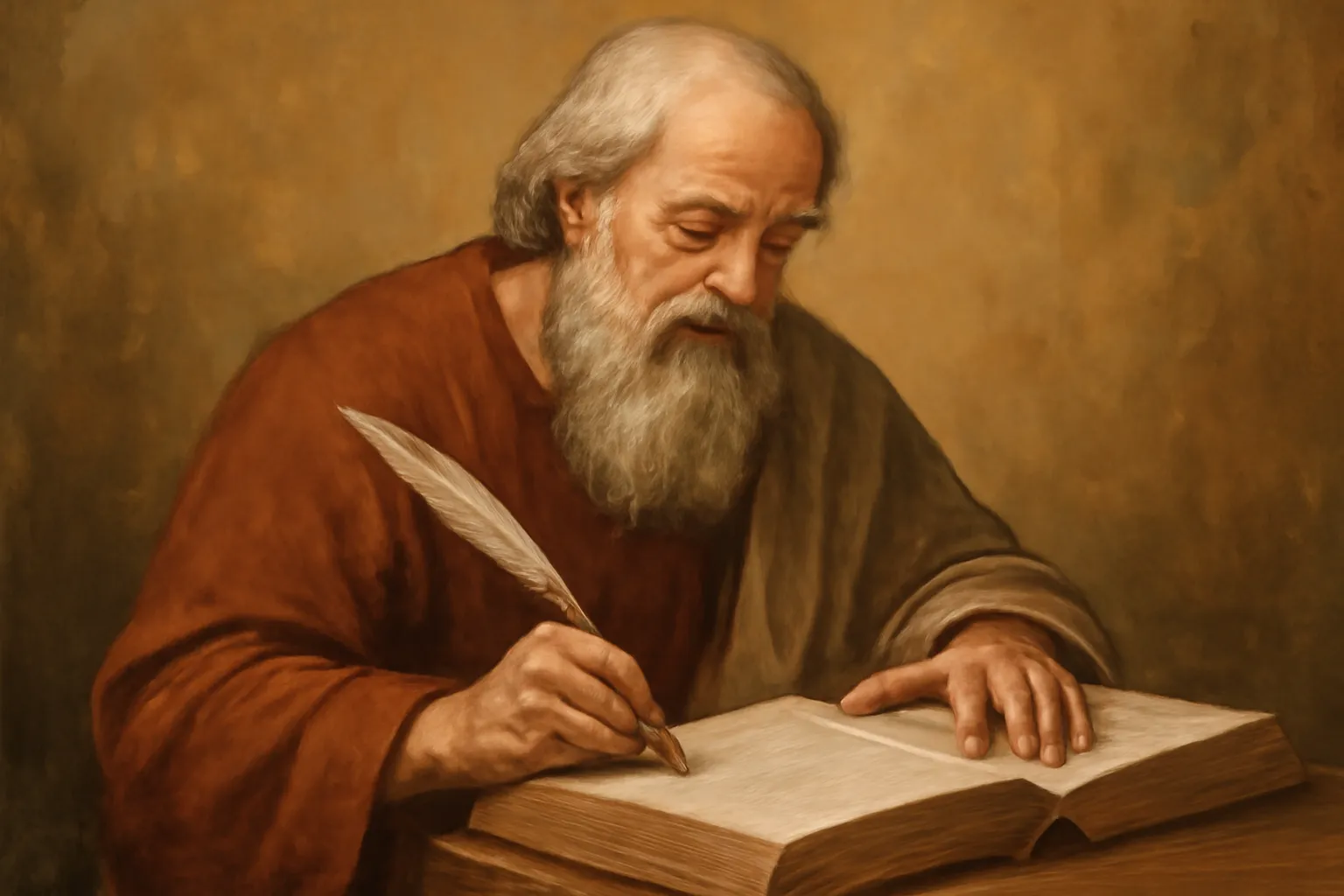
The Bible is a remarkable library assembled over many centuries, written by a diverse group of bible authors who spoke to different communities, in different times, and in different genres. Because the Bible contains historical narratives, poetry, prophetic oracles, letters, and apocalyptic visions, the question of authorship invites careful study. This article surveys who traditionally wrote the books of the Bible, what modern scholarship suggests, and how scholars understand the process by which these sacred texts came to be compiled. It is helpful to keep in mind that the concept of inspiration and the sense in which the human writers carried out their roles can coexist with a nuanced view of authorship that reflects historical development and literary artistry.
In biblical studies, three related ideas are often distinguished: traditional attribution, internal evidence within the texts themselves, and historical-critical assessment based on linguistic, cultural, and manuscript data. Traditional attribution refers to the long-standing identifications found in church history and the way copies and commentaries present the author’s name. Internal evidence looks at clues such as writing style, historical references, and self-designations within the text. Historical-critical assessment examines sources, redaction, and editorial layers that may have shaped a book over time. Together, these approaches help us understand the likely shape of the biblical authorship without denying legitimate uncertainty in some cases.
The Old Testament / Hebrew Bible: overview of authorship
The Hebrew Bible presents a broad tapestry of voices. While some books are linked to well-known figures, many were produced or edited by communities—priests, scribes, prophets, and editors—who gathered earlier materials and framed them for contemporary readers. Here is a survey by big sections, highlighting traditional views and modern scholarly perspectives.
The Pentateuch (the first five books: Genesis, Exodus, Leviticus, Numbers, Deuteronomy)
The Pentateuch has long been associated with Mosaic authorship, the idea that Moses wrote these foundational books under divine inspiration. This traditional view has shaped religious teaching for centuries. At the same time, modern critical scholarship often argues that the Pentateuch reflects multiple sources and editors over time. The dominant framework in contemporary academia is the documentary hypothesis, which identifies several strands or sources that were woven together.
J source (the Yahwist): Characteristically uses the divine name Yahweh and presents a vivid, anthropomorphic sense of God. It provides many early narratives and a narrative voice that emphasizes human experiences and relationships.
E source (the Elohist): Often uses Elohim for God and emphasizes dreams, visions, and a priestly perspective important for later traditions.
D source (the Deuteronomist): Central to Deuteronomy and the history books, with a focus on covenant fidelity, law, and the consequences of obedience or disobedience.
P source (the Priestly tradition): Emphasizes rites, genealogies, liturgical material, and a priestly worldview. It contributes substantial material to Genesis 1 and the Levitical laws.
Scholars argue that these strands were edited together by later redactors to produce a coherent narrative that serves the theological aims of the community. In this view, the name Moses remains a traditional attribution that communicates the authority and ancient provenance of the text, even if the name does not reflect a single, solitary author in the modern sense.
Key considerations about the Pentateuch
The opening chapters of Genesis show deep, universal themes—creation, fall, flood—handled by multiple voices in the text.
Exodus and Leviticus carry strong priestly concerns, rituals, and statutes that align with the >P< summary of material.
Deuteronomy serves as a bridge between law and history and is often viewed as a later editorial layer shaping the theological program of the entire Pentateuch.
The historical books cover extensive periods and narrate the rise and fall of kingdoms, the exile, and the return to land and temple. The authorship of these books is frequently anonymous, but scholars discuss editorial currents that shaped their final form.
Editorial layers: Many of these books reflect a later historian or conglomerate of scribes who compiled earlier material and wrote with a particular theological purpose, often under the influence of the exile and the post-exilic community.
Deuteronomistic history: A scholarly term referring to a broad editorial program that has a distinctive voice in the narrative from Deuteronomy through 2 Kings. This perspective emphasizes covenant faithfulness, idolatry, and the consequences of national choices.
Anonymous authorship and redaction are common, though the final form is often attributed to genealogical or priestly circles who preserved and edited records for posterity and worship.
Within this section, the books of Chronicles (1–2 Chronicles) present a notable angle: a retrospective, temple-centered history that sometimes revises or reframes material found in Samuel and Kings. Chronicles is often linked with the post-exilic community and is attributed to a chronicler or chroniclers associated with Israel’s temple worship and the priestly line. Yet even here, modern scholars stress editorial shaping as a central feature rather than a single author who penned the entire narrative at one sitting.
Key considerations about the historical books
Chronicles reframes earlier history with a focus on Judah’s temple, Levitical service, and the Davidic line, offering a different lens on the same overarching history.
Samuel, Kings, and the Deuteronomistic history present a recurring pattern of covenantal faithfulness and its consequences, interpreted through the experiences of prophets and kings.
Ezra-Nehemiah blends historical reporting with a post-exilic religious and community rebuilding agenda, suggesting a layered authorship or editorial program.
Wisdom and Poetry: Job, Psalms, Proverbs, Ecclesiastes, Song of Songs
The wisdom literature and poetical books of the Old Testament contribute a broad spectrum of literary voices. Their authorship is especially varied, with contributors ranging from traditional figures to anonymous collectives.
Psalms: A diverse collection of hymns and prayers, with Davidic authorship claimed for many, but a larger portion attributed to other leaders such as Asaph, Sons of Korah, Solomon, and various liturgical editors. The Psalter’s final form reflects centuries of musical and devotional usage.
Proverbs: Traditionally linked to Solomon as the primary author, but modern scholarship recognizes material from later sages and editors who added proverbs, cautionary sayings, and lesson-based poetry.
Job: A complex piece that likely has multiple layers and voices. While tradition sometimes attributes it to a figure named Job, the actual composition probably reflects an evolving dialogue about suffering, righteousness, and divine sovereignty.
Ecclesiastes: Often associated with Solomon, yet scholars emphasize a later redactor or an inner voice speaking through a pseudonymous teacher, presenting reflective, sometimes skeptical, questions about meaning and time.
Song of Songs: A poetic collection celebrating romantic love, sometimes attributed to Solomon in the tradition, but many scholars argue for a later, symbolically rich composition and an anthology by multiple authors or editors.
The wisdom tradition in particular is less about a single author and more about a lineage of wisdom teachers, editors, and communities that valued moral instruction, practical counsel, and meditative reflection on life and God.
Prophetic Books: Major and Minor Prophets
Prophets speak with a conscience toward the present, calling rulers and people to fidelity to the covenant. The prophetic corpus contains both individual voices and broader prophetic movements.
Major Prophets: Isaiah, Jeremiah, Ezekiel, and Daniel are traditionally termed major due to their long writings and weighty themes. The attributions reflect a range of historical settings—from Assyrian and Babylonian contexts to Jewish exile and post-exilic return. In particular, the book of Isaiah is often discussed as a unity by tradition but viewed by many scholars as containing multiple literary phases (commonly distinguished as First, Second, and sometimes Third Isaiah).
Minor Prophets: The twelve shorter prophetic books (Hosea through Malachi) are called “minor” not for importance but for length. They likely reflect multiple authors and communities across several centuries, each addressing specific historical moments and social concerns.
In both groups, the question of authorship is often secondary to the prophetic message: God’s call to repentance, hope for justice, and the assurance of God’s coming kingdom. The tradition offers names for some books (e.g., Isaiah or Jeremiah) while scholars may highlight composite authorship, redactors, or editorial sequences that shaped the final form.
The New Testament: authorship, attribution, and the shape of the church’s writings
Moving to the New Testament, the question of authorship becomes equally important, yet more debated in places. The four canonical Gospels—Matthew, Mark, Luke, and John—are joined by Acts of the Apostles and a collection of Epistles (letters) and an apocalypse (Revelation). The traditional attributions have strong early church backing, but modern scholarship often reads the texts with more attention to linguistic evidence, audience, and historical context.
The Gospels and Acts
The gospels tell the story of Jesus and his followers in different voices and for different communities. The book of Acts continues the narrative, focusing on the early church’s life and mission. The traditional attributions are:
The Gospel of Matthew: Attributed to Matthew the tax collector, a First-Century Jewish-Christian author who wrote for a Jewish-Christian audience. The gospel emphasizes Jesus as the fulfillment of Hebrew scripture and portrays Jesus’ teaching in a manner accessible to readers familiar with Israel’s scriptures.
The Gospel of Mark: Traditionally linked to Mark the companion of Peter. Often considered the earliest gospel, Mark presents a concise, action-oriented account and is frequently used as a source by Matthew and Luke (the Synoptic Problem).
The Gospel of Luke: Attributed to Luke the physician, a companion of Paul. Luke’s gospel is known for its careful historical sense, attention to marginalized people, and a two-volume work that continues in Acts.
The Gospel of John: Attributed to the Apostle John in early church tradition, though modern scholarship debates the precise identity of the author and the possibility of a Johannine community behind the text. John’s gospel emphasizes the identity and divinity of Jesus in a distinctive theological tone.
Acts is traditionally ascribed to Luke as well, forming a two-volume work with Luke’s gospel. Acts documents the spread of the early church, the ministry of Peter and Paul, and the growth of Christian communities across the Mediterranean world. Inside these books, authorship is often intertwined with the author’s purpose, audience, and theological aims rather than with a single, purely historical biographer.
The Epistles (letters)
Pauline letters are among the earliest Christian writings, and they have played a central role in shaping Christian doctrine and practice. The traditional view identifies Paul as the author of several letters, though some letters’ authorship is debated in light of style, vocabulary, and historical claims. Other letters are attributed to other leaders in the early church, including James, Peter, John, and Jude. The Pauline corpus includes a mix of clearly Pauline letters and sometimes disputed or disputed-attribution letters.
Major Pauline letters: Romans, 1 Corinthians, 2 Corinthians, Galatians, Philippians, 1 Thessalonians, Philemon. These are generally accepted as authored by Paul and reflect his missionary experiences and theological concerns about justification, church life, and eschatology.
Pastoral and disputed letters: Ephesians, Colossians, 2 Thessalonians, 1–2 Timothy, Titus. These letters are often discussed in terms of stylistic differences, church structure, and later theological concerns; many scholars regard some of them as written by followers of Paul after his lifetime, using Paul’s name to address contemporary issues.
General (Catholic) epistles: James, 1–2 Peter, 1–3 John, Jude. These letters are addressed to broader Christian audiences and reflect distinct voices, concerns about faith in action, endurance, and moral instruction.
Hebrews is a special case in the New Testament authorship conversation. The precise author remains uncertain in scholarly circles, with traditional claims pointing to Paul in some early manuscripts, while modern scholarship recognizes a distinct rhetorical and theological style that sets Hebrews apart from Paul’s other letters. As a result, Hebrews is usually treated as a work of an early Christian teacher or theologian who wrote in the late first century or early second century.
Revelation
The final book of the New Testament, Revelation, is commonly attributed to John the Apostle in early Christian tradition, but many scholars debate the exact identity of the author. The text itself identifies a “John” on the island of Patmos, but the name could refer to a Johannine community or a figure connected to that community. The book is renowned for its symbolic language, apocalyptic vision, and hopeful message about God’s ultimate victory over evil.
How scholars determine authorship: methods and challenges
Scholars use a suite of methods to study authorship. While not every book yields definitive answers, these tools help establish the most plausible scenarios about who wrote or shaped a book and why. Key methods include:
Internal evidence: Examining how the text refers to itself, its audience, historical events, and its own vocabulary and style.
External testimony: Looking at early church traditions, quotations by early church fathers, and manuscript attributions that circulated in antiquity.
Language and style analysis: Using linguistics to compare vocabulary, syntax, and rhetorical patterns across different parts of a text or across a corpus of related writings.
Source criticism and redaction: Probing for multiple sources, editors, and compositional layers that contributed to the final form of a book.
Historical context: Aligning the material with known historical events, social settings, and religious movements of the relevant periods.
It is important to note that some books display strong unity and a clear voice, while others show a composite texture that points to editors integrating earlier material. In all cases, the goal is not to undermine the authority of Scripture but to understand the human processes by which God’s message was transmitted through human authors and communities over time.
Why authorship matters for readers and faith communities
Understanding who wrote a book can illuminate its purpose, audience, and theological emphases. When readers know that a Gospel, a prophetic collection, or a letter bears the imprint of a particular community’s concerns, they can better interpret the message in its historical and literary context. Some practical implications include:
Contextual reading: Recognizing cultural, historical, and literary contexts helps in grasping themes such as covenant faithfulness, messianic expectation, or ecclesial practice.
Theology and unity: While authorship may vary, the canon presents a coherent arc—creation, fall and redemption, restoration, and the promised culmination of God’s kingdom—in which diverse voices contribute to a shared faith.
Hermeneutical humility: Acknowledging uncertainty about authorship invites careful interpretation and respect for both traditional understandings and scholarly insights.
Common misconceptions about biblical authorship
Several ideas about who wrote the Bible can mislead readers if taken without nuance. Here are a few clarifications:
There was always a single author per book: In many cases, books emerge from multiple authors, editors, and communities assembled over time. A single “author” is not always the best way to understand a given text.
All books have precise, verifiable authors: While a few titles carry strong historical attributions, others are uncertain, and in some cases the author is anonymous. Historical traditions often provide a name, but it may reflect later reverence or descriptive tradition rather than a proven authorship.
Authorship equals inspiration: The belief that the Bible is divinely inspired does not necessarily require the literal, historical identity of every author to be known with certainty. Inspiration works through human voices across centuries and cultures.
Putting it all together: a landscape of biblical authorship
The Bible’s authorship landscape is best understood as a spectrum. On one end are narrow attributions tied to well-known figures (for example, Moses in the traditional Pentateuch, David in some Psalms, Paul in many New Testament letters). On the other end is a broad array of contributors—priests, scribes, prophets, missionaries, and editors—whose work spans tribal and national boundaries, languages (Hebrew, Aramaic, Greek), and centuries. This plurality of voices underwrites the Bible’s enduring power and its capacity to address varied readers across time.
Practical guidelines for readers exploring authorship
If you want to deepen your study of biblical authorship, here are some practical steps and considerations that can guide your reading:
Consult introductions to each book: Most study Bibles, commentaries, and scholarly introductions summarize traditional attributions and modern scholarship in a concise way.
Note the genre: Narrative history, poetry, wisdom literature, prophetic oracles, and letters each have different conventions that influence how we understand authorship and authority.
Consider context: The historical circumstances surrounding a book influence its purpose and the likely contributors who compiled and edited it.
Be mindful of redaction: Recognize that editors may have shaped the text to address new audiences, crises, or theological issues without negating the text’s spiritual significance.
A living conversation across centuries
Ultimately, the question of bible authors is more than a catalog of names. It is part of a living conversation about how God spoke through ordinary people, how communities remembered and interpreted those messages, and how later generations preserved them for faith today. The Bible’s breadth—covering creation, covenants, laws, pilgrimages, poetry, wisdom, prophecy, gospel good news, church-centered letters, and apocalyptic vision—reflects a chorus rather than a single voice. Each author or editor contributes a unique timbre to the chorus, inviting readers to listen, interpret, and apply the message in new circumstances without losing sight of the overarching narrative of God’s redeeming work in history.
As you continue to study, you may encounter more precise scholarly arguments about particular books or series. Treat these as part of a larger endeavor: to understand the Bible as a collection that communicates a coherent story through many voices. Whether you emphasize traditional attributions or appreciate the nuanced theories of modern scholars, the central aim remains the same: to encounter the living text that has shaped faith, worship, and moral reflection for countless generations.