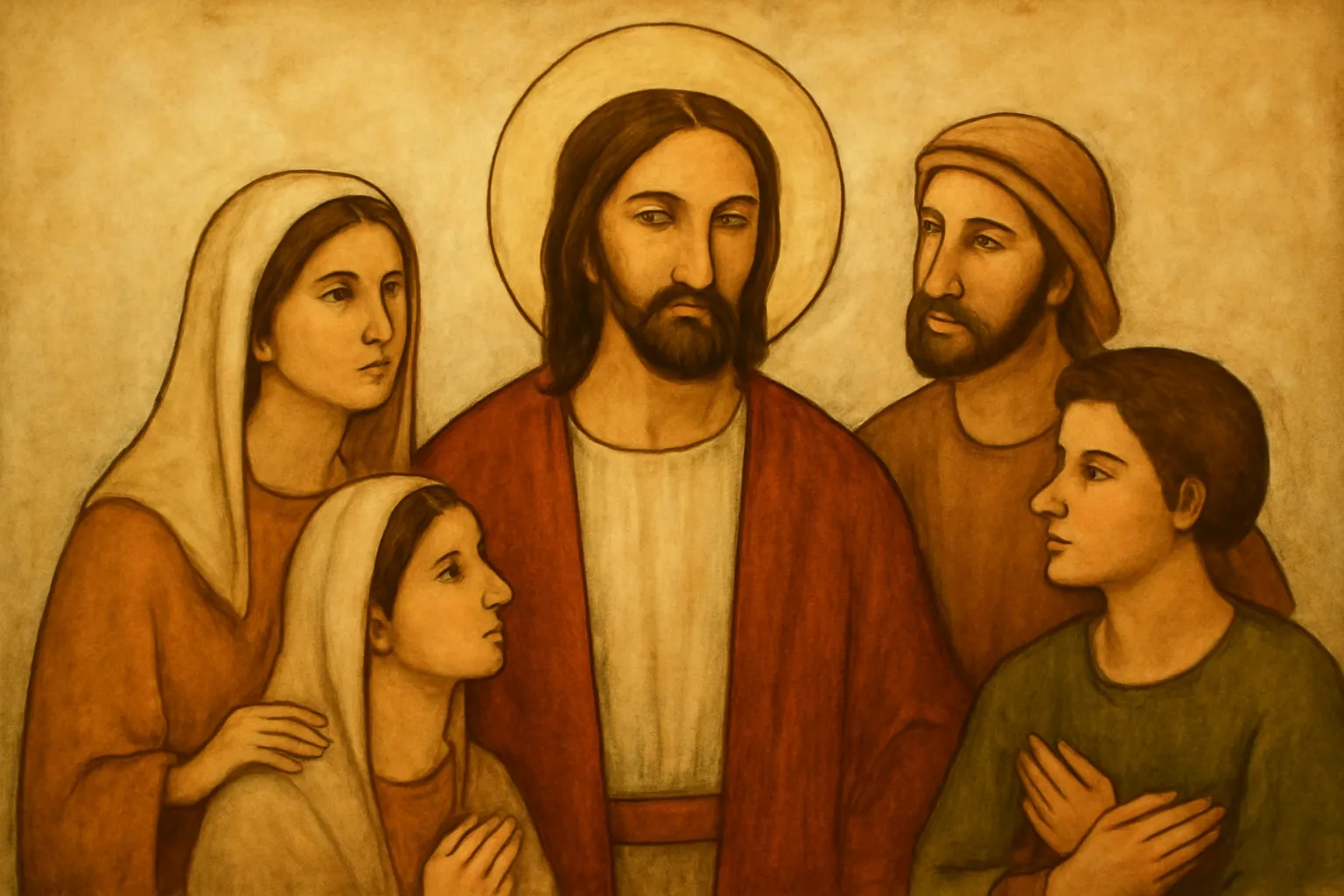
The question of who were Jesus’s brothers and sisters is more than a curiosity about family trees. It touches on how the earliest Christians understood the human life of Jesus, the way they spoke about kinship, and the evolving traditions about Mary, the mother of Jesus, and the succession of leadership in the early church. In the Gospel narratives, Jesus grows up in a concrete family milieu, and the text names several siblings, while other passages hint at the broader circle of kin and acquaintances connected to Jesus. For many readers, disentangling these names from later theological debates—such as Mary’s perpetual virginity or the meaning of adelphoi in Greek—helps illuminate both the historical context and the interpretive currents that shaped Christian faith.
This article explores Jesus’s brothers and sisters as they appear in the Bible, what the texts say about them, who they were, and how scholars and traditions have understood their identity and role. We will survey the key biblical passages, discuss the linguistic questions surrounding the Greek term adelphoi, and outline the main interpretive positions in the history of Christian thought. The aim is not merely to catalog names but to present a nuanced picture of the siblings of Jesus within the biblical record and the broader religious imagination that grew from it.
What the Bible says about Jesus’s brothers and sisters
The New Testament contains several explicit references to Jesus having brothers and sisters, though the exact meaning of those terms has been the subject of discussion. The word often cited is adelphos, a Greek term that can mean biological brother, a close male relative, or, in some contexts, a broader kinship. The Gospel writers use this term in ways that invite careful reading.
In Matthew 13:55-56, the crowds ask: “Isn’t this the carpenter’s son? Aren’t his brothers James, Joseph, Simon and Judas with us? And his sisters, are they not all with us?” This passage is one of the clearest biblical references to Jesus’ brothers and to unnamed sisters.
In Mark 6:3, a parallel version states: “Isn’t this the carpenter, the son of Mary, and brother of James and Joses and Judas and Simon? And are not his sisters here with us?” The order and the names align with Matthew’s account but differ slightly in phrasing, illustrating how the Gospel writers preserved oral traditions in distinct ways.
The phrase “his brothers and sisters” is sometimes translated as “his brothers and his sisters” or “his siblings,” and the lack of named sisters in most manuscripts underscores a common feature of ancient texts: female family members are often unnamed, while male relatives are listed explicitly.
In Galatians 1:19, Paul notes, “But I did not see any other of the apostles except James, the Lord’s brother.” This reference moves beyond the Gospels to the apostolic circle and highlights a particular familial link to Jesus through James, often rendered as James the brother of the Lord in tradition.
The Acts of the Apostles and later epistles also reflect the prominence of certain siblings in early Christian leadership, though the texts do not always provide a complete family tree. The presence of Jesus’s siblings in early church life is a subject of ongoing scholarly discussion, but the core biblical data point to a cluster of named brothers and at least some unnamed sisters.
Together these passages establish a baseline: Jesus had brothers with names in some sources, and at least the existence of sisters is attested by the language of the Gospels. The exact interpretation of adelphoi—whether these were biological siblings, step-siblings, cousins, or close kin—remains a central question for translators, commentators, and theologians.
Who were the named brothers? The brothers named in the Gospel records
A core part of the discussion concerns the individuals named as Jesus’s brothers in the canonical Gospels. The lists vary slightly between Matthew and Mark, but a consistent set emerges:
James
Joseph (often rendered as Joses in some translations)
Simon
Judas (sometimes distinguished by context from Judas Iscariot, though the two references are in different senses in early texts)
In Mark 6:3, the list appears as “James and Joses and Judas and Simon.” In Matthew 13:55-56, the same four brothers are named in a slightly different order, with the crowd asking about their sisters as well. The shared elements across these passages give scholars confidence that the text refers to four male siblings of Jesus by name, at least in the early Christian memory.
The variant “Joses” is sometimes read as a short form of “Joseph”, which can lead to translational questions about how the family was known in Aramaic or Hebrew circles before the Gospel writers translated and written in Greek. Some manuscripts preserve the form “Joseph” rather than “Joses”, and the choice of spelling can influence how readers visualize the family tree.
The sisters: Unnamed yet acknowledged
Less is said about Jesus’s sisters in the canonical texts. The Gospels explicitly refer to “his sisters” as part of the statement that Jesus did not perform miracles in Nazareth due to people’s skepticism. The sisters are not named in the surviving verses, which has led some readers to wonder about their identities and roles.
The phrase in Matthew 13:56—“And his sisters, are they not all with us?”—implies there were multiple sisters, but the text does not supply individual names. This pattern—named brothers, unnamed sisters—appears in several ancient manuscripts and reflects a common practice in naming male kin more often than female kin in some textual traditions.
Some later traditions and hagiographical works attempt to identify sisters by name or to describe their life trajectories, but these attributions are not part of the canonical Gospel records. Therefore, for biblical purposes, the sisters of Jesus remain unnamed siblings in the Gospel narrative.
The absence of names for Jesus’s sisters in the Bible has mattered for both devotional and scholarly reasons. It invites careful handling of gender and kinship in early Christian communities, reminding readers that women played roles in Jesus’s circle even when the earliest texts emphasize male leaders and male kinship ties.
Different ways of reading adelphoi: Biological siblings, cousins, or close kin?
A central question about Jesus’s brothers and sisters is how to interpret the Greek term adelphoi in the New Testament. The term can mean:
Biological brothers or sisters, sharing the same mother and father.
Cousins or close relatives, in the broader sense of kinship when familial language overlaps with social circles.
Step-siblings, if Mary had more children after Jesus through a previous marriage of Joseph (a theory not widely supported in early Christian tradition but discussed in some circles).
Close associates or spiritual family, where the term reflects a broader sense of belonging within the Christian community, especially in the letters where believers are described as brothers and sisters in Christ.
The exact sense of adelphoi has implications for how we understand the early community. If the brothers and sisters are biological, they would represent Jesus’s immediate family; if they are extended kin, the label reveals the social web around Mary and Jesus; if they are spiritual, it would reflect a metaphorical family characteristic of the early church. Bible scholars weigh textual evidence, ancient naming conventions, and patristic commentary to produce balanced interpretations.
Key figures among the siblings and their later roles
Among the named brothers, a few stand out because of their later prominence in the early church. The most discussed is James, often identified as James the Just or the brother of the Lord, who emerges as a central figure in Jerusalem circles after Jesus’s resurrection.
James the Just is mentioned in the New Testament as someone significant in the early church leadership in Jerusalem. In Galatians 1:19, Paul recalls meeting “James, the Lord’s brother.” This James is often associated with leadership responsibilities in the early Christian community and the decision-making process at the Council of Jerusalem (Acts 15).
Judes/Judas appears as one of the brothers in the Gospel lists, but a related figure emerges later in tradition as Jude (often identified with Judas the brother of James mentioned in Luke 6:16). In the Epistle of Jude, the author identifies himself as “a servant of Jesus Christ and brother of James,” which has led many scholars to connect this Jude with one of Jesus’s brothers, though the exact genealogical mapping remains debated.
Joseph (Joses) and Simon appear in the brief Gospel lists, and their exact later roles are less clearly documented in canonical material. Some traditions and later church writings attribute to them various circles of activity or leadership, but these attributions are not uniformly attested across sources.
These figures—especially James and Jude—played a pivotal role in shaping the early church’s structure, theology, and mission. The fact that one or more of Jesus’s brothers attained a leadership position highlights how the early Christian community often saw family networks as natural channels for religious authority and continuity.
Historical and theological interpretations across traditions
The question of whether Jesus’s brothers and sisters were biological siblings or cousins has generated divergent interpretations across Christian traditions. Although the canonical texts themselves do not settle every detail, the ensuing centuries have produced a spectrum of views, often tied to broader doctrines about Mary, virginity, and the nature of Jesus’s family life.
The biological-siblings view
This view holds that Jesus’s brothers and sisters were the children of Mary and Joseph, i.e., Jesus’s full siblings. Proponents point to Matthew 13:55-56 and Mark 6:3 as clear evidence that Jesus had multiple Jewish siblings who grew up in Nazareth. Supporters of this interpretation often emphasize the normalcy of family life in first-century Israel and argue that the Gospel writers’ lists reflect literal kinship.
The cousins or extended kin view
Some scholars and readers consider the possibility that the terms refer to cousins or other close kin rather than direct siblings. In the cultural context of the time, extended family networks were tight, and kinship terms might be stretched to cover a range of relationships. This view frequently arises in discussions about Mary’s perpetual virginity, as a way to maintain Mary’s special status while still recognizing Jesus’s broader family network.
The spiritual-family and broader-community view
Another range of perspectives treats the phrase “brothers and sisters” as a broader sign of social and spiritual kinship—not just biological. In this reading, the terms can denote fellow believers, close friends, or members of the same faith family. This approach emphasizes the way early Christians spoke of the church as a family and uses kinship language to describe belonging and loyalty within the community.
Across traditions, the role of Mary is a key point of discussion. Some traditions assert the perpetual virginity of Mary, which has concrete implications for how to interpret Jesus’s siblings. Others reject that claim and accept the canonical data as indicating that Mary had other children after Jesus. These disputes have shaped liturgical practices, devotional life, and ecclesial teachings for centuries.
Mary and the question of perpetual virginity
The topic of Mary’s perpetual virginity intersects with the question of Jesus’s brothers and sisters in a historically significant way. In Catholic and some Eastern Orthodox traditions, Mary is often understood to have remained a virgin throughout her life, which leads to interpretations where Jesus’s siblings are explained by alternate familial relationships (for instance, as cousins or step-siblings in certain readings). In many Protestant traditions, the canonical data are interpreted as indicating that Mary had other biological children with Joseph after Jesus’ birth.
Proponents of the perpetual-virginity view argue that the Gospel writers occasionally use adelphoi in a broader sense and that Mary’s unique role in salvation history warrants extraordinary explanations about her virginity. They often appeal to early church testimonies, patristic commentaries, and certain iconographic traditions to support their position.
Critics of perpetual virginity emphasize the explicit Gospel statements of Jesus’s siblings and the normal pattern of kinship in first-century Jewish life. They cite passages like Matthew 13:55-56 and Mark 6:3 as straightforward mentions of biological brothers and sisters.
The debate has shaped centuries of theological reflection and has influenced Christian practice, art, and devotion. The question matters not only for biblical exegesis but for how communities conceive the family of Jesus and the way early Christians understood kinship and discipleship.
Patristic and scholarly perspectives: how the early church read the siblings
The early church fathers offered a range of readings about Jesus’s brothers and sisters, often influenced by their broader theological commitments. Some prominent lines of thought include:
Jerome and other Western writers sometimes favored the view that Mary remained a virgin, hence minimizing the biological interpretation of Jesus’s siblings, while still acknowledging the possibility of extended kin connections in some readings.
Eusebius and other patristic authors sometimes referenced Jesus’s brothers as significant players in Jerusalem church life, highlighting James as a leading figure after the Resurrection.
Vatican and Orthodox tradition have held varied positions across centuries, with some emphasizing the perpetual virginity and others accepting a more literal reading of the Gospel texts.
Modern scholarship tends toward nuanced readings of adelphoi, considering linguistic, cultural, and textual factors, and acknowledging the possibility of multiple related readings within the same texts.
Contemporary biblical studies often present a balanced approach: the Gospels clearly name several male siblings of Jesus, while the female siblings are not named in canonical text. The exact relationships, whether biological or kinship-based, remain a fruitful area for historical and literary analysis.
Practical takeaways: what this means for readers today
For readers and students of the Bible, the question of Jesus’s brothers and sisters offers several practical insights:
Historical context matters: The names and terms used in the Gospel texts reflect a particular historical and cultural setting—one in which family ties and kinship networks were central to identity and social organization.
Language matters: The Greek term adelphos covers a range of kinship possibilities. Understanding this helps readers approach the text with nuance and avoids over-simplified conclusions about immediate family structure.
Tradition shapes interpretation: Across centuries, different Christian traditions have read the same texts in distinct ways, with implications for doctrine, devotional life, and art.
Biographical focus: The siblings named in the Gospels—James, Joseph/Joses, Simon, Judas—are part of the broader story of Jesus’s early life, but their subsequent roles in church history highlight how the family remained connected to Jesus’s mission after the Resurrection.
In sum, the biblical record preserves a real and named set of brothers and a broader implication of sisters in Jesus’s life, while the precise nature of their relationship to Jesus continues to be a topic that invites thoughtful examination and respectful dialogue across traditions.
Frequently asked questions and common myths
Did Jesus have biological sisters? The Gospels clearly refer to “his sisters,” but they do not name them; many scholars interpret this as biological sisters, while others propose extended kinship terms. The canonical data support the existence of sisters without naming them, leaving room for interpretation.
Are Jesus’s brothers named James, Joses, Simon, and Judas? Yes, those four names appear in the Gospels of Matthew and Mark as Jesus’s brothers.
Is James the same person as James, the leader in the Jerusalem church? In the New Testament, James the Just is often linked to Jesus’s brother by tradition and by Paul’s reference in Galatians; many scholars identify him as the same James who rose to prominence in Jerusalem. However, some early tradition preserves separate identifications; most modern scholarship treats him as the same individual.
Why is the topic important for understanding early Christian leadership? Because the siblings of Jesus, especially James, show how a family network could influence authority and leadership in the earliest Christian communities, shaping how faith communities formed and governed themselves in the first century.
reflecting on Jesus’s family in the biblical narrative
The brothers and sisters of Jesus appear as a small but telling thread in the fabric of the New Testament. Their presence confirms Jesus’s humanity and his place within a living, breathing family context, while their later roles—especially that of James—highlight how the earliest believers leveraged kinship to organize, lead, and transmit the message of Jesus. Whether one views these siblings as direct biological kin, as close kinship in a broader sense, or as symbolic members of a spiritual family, the essential point remains: Jesus’s household did not vanish after his public ministry. Instead, his family and their experiences continued to shape the early Christian community, influencing decisions, leadership, and the unfolding story of the church.
The study of Jesus’s brothers and sisters thus serves as a bridge between the historical Jesus and the early church, inviting readers to engage with biblical texts attentively, consider multiple scholarly interpretations, and acknowledge the diverse ways communities have understood these relationships across time.