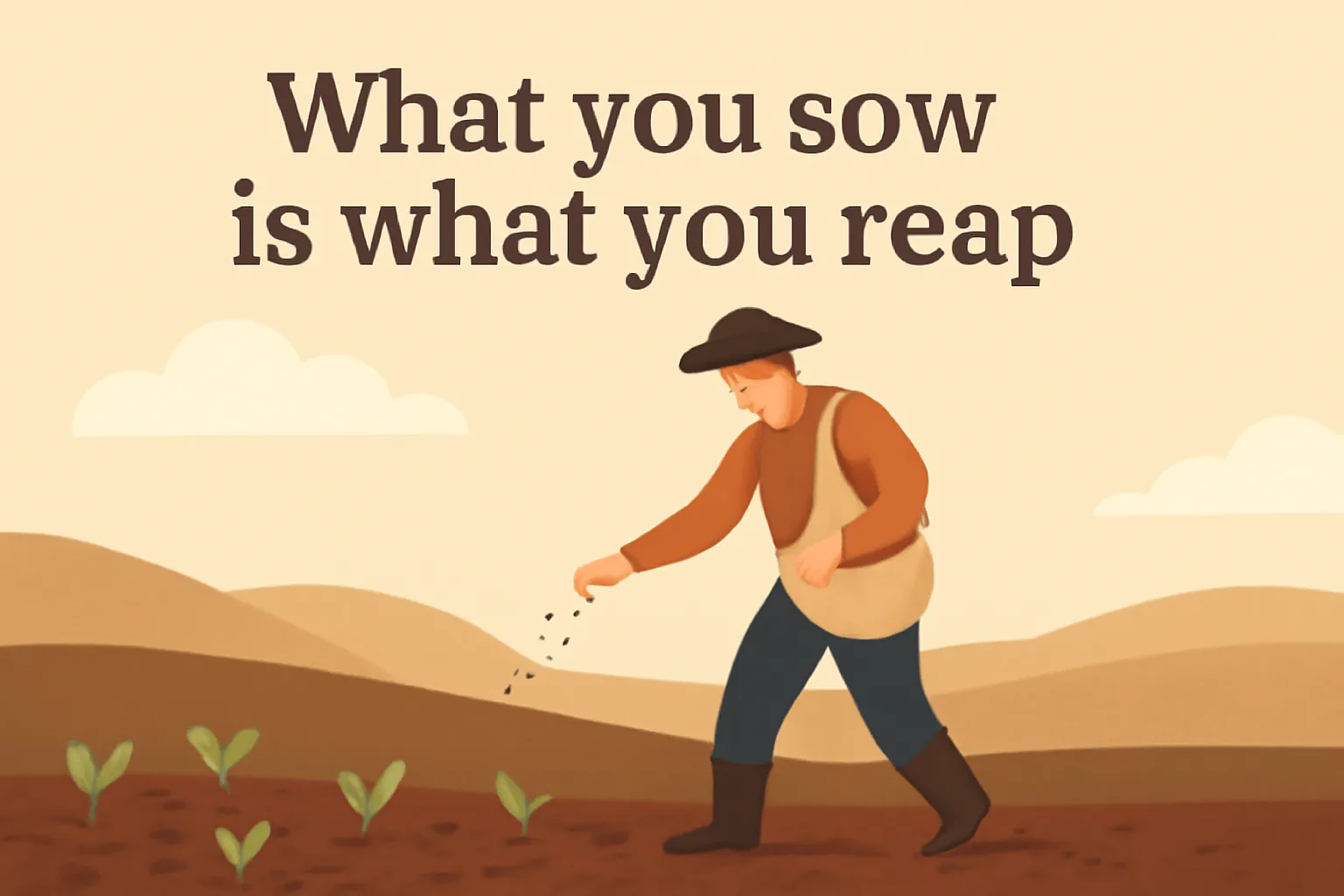
The Timeless Principle Behind What You Sow Is What You Reap
The phrase “What you sow is what you reap” speaks to a deep and practical truth about life, morality, and the rhythms of action and consequence. It is more than a pithy maxim; it is a spiritual and ethical principle woven into Scripture, culture, and everyday experience. This article explores the meaning of the phrase, traces its biblical roots, and reflects on how it can shape our choices, relationships, and habits. While the wording of this idea is familiar, its nuance runs through both Old Testament wisdom and New Testament teaching, inviting readers to consider seeds planted, seasons of growth, and the harvest that follows.
Throughout history, people have used variations of this idea to encourage responsibility, generosity, and integrity. You may hear it echoed as “you reap what you sow”, “as you sow, so shall you reap”, or in a more explicit form from Galatians 6:7, a verse that anchors this law of cause and effect within the Christian faith. As you read, you will encounter not only the moral imperative but also the grace-filled dimension of growth—how mercy, repentance, and transformation can alter the trajectory of a life.
Scriptural Foundations: Where the Principle Is Found
The core idea appears in multiple biblical places, often using agricultural imagery to describe how human actions bear fruit in time. The most direct formulation is found in Galatians 6:7 (in traditional translations): “Be not deceived: God is not mocked: for whatsoever a man soweth, that shall he also reap.” This short verse emphasizes intentionality, reciprocity, and divine sovereignty: the seeds we plant will yield a corresponding harvest, and God will not be fooled by appearances.
In the KJV rendering and other public-domain translations, this verse stands beside related lines that expand the moral landscape. Consider a few companion expressions that illuminate the same principle:
“Whatsoever a man soweth, that shall he also reap” (Galatians 6:7). A concise, declarative statement about cause and effect in moral life.
“Be not deceived: God is not mocked”—the warning against manipulating outcomes apart from the truth of one’s deeds.
“They sow the wind, and they reap the whirlwind” (Hosea 8:7). A stark image of disproportionate harvests that follow reckless sowing.
“He that soweth iniquity shall reap vanity” (Job 4:8, KJV). A refrain that links moral choices to empty, wasted outcomes.
Beyond these direct lines, the biblical corpus contains many passages that describe seedtime and harvest as a way of explaining justice, wisdom, and character formation. In the life of the people of Israel, sowing and reaping are not merely natural facts but signs of covenant faithfulness: fidelity to God brings blessing; rebellion yields consequences. In the New Testament, Jesus and the apostles expand the theme to include generosity, mercy, and spiritual dispositions that generate enduring fruit.
Key Verses to Consider
Galatians 6:7 (Be not deceived… whatsoever a man soweth, that shall he also reap.)
Hosea 8:7 (They sow the wind, and they reap the whirlwind.)
Job 4:8 (They that plow iniquity, and sow wickedness, reap the same.)
Luke 6:38 (Give, and it shall be given unto you…)—a related teaching about reciprocity in generosity.
Taken together, these passages help readers see that the principle operates across both the moral and spiritual economies. The seed you plant—whether kindness, truth-telling, or generosity; or vice versa, anger, deception, and exploitation—tends to grow into a harvest that reflects its origin. Yet Scripture also invites trust in God’s overarching redemptive plan: even when we fail to reap immediately, or when the harvest seems small, grace and transformation remain possible as we turn toward righteousness and repentance.
The Metaphor of Sowing and Reaping: How Seeds Grow into Harvests
The sowing-and-reaping metaphor operates on several levels. At the most concrete level, a farmer sows seeds and waits for rain, soil, and time to work their magic. But in scripture and spiritual reflection, the seeds are not just kernels of grain; they are choices, habits, and attitudes that shape a person’s character and future. The harvest is more than a crop; it is the visible fruit of a life—the relationships nurtured, the trust built, the wisdom earned, the healing offered or withheld.
There is a rhythm embedded in this idea: intention precedes outcome, which in turn invites responsibility. When we choose to sow kindness, patience, or courage—especially when it costs us something—we are investing in a future that can multiply those very blessings. Conversely, sowing deceit, cruelty, or bitterness often yields a harvest of brokenness. The pattern is not a lazy formula; it is a trust-filled invitation to participate in a world that responds to acts of love, truth, and justice.
The Layer of Timing: Immediate Seeds vs. Delayed Harvest
It is important to recognize that seeds may take time to produce. Some crops germinate quickly, offering near-immediate signs of growth; others require seasons, patience, and even seasons of trial before fruit becomes evident. In biblical terms, some deeds bear fruit in the near future—today’s choices shaping today’s circumstances—while others mature slowly, advanced by the patient cultivation of faith and obedience. This timing nuance helps explain why people can do good without seeing instant reward, or witness consequences long after the initial action.
Natural Law and Moral Law: Two Realities Under One Principle
The sowing-and-reaping idea sits at the intersection of natural law—how life operates in a physical sense—and moral law—the way virtue or vice shapes destiny. In everyday experience, we observe that careful planting yields steady harvests, and neglect or harm can lead to eroded soil and diminished crops. In moral life, generous acts cultivate trust and community, while selfish or violent acts corrode relationships. The biblical authors invite readers to attend to both orders: to respect natural rhythms and to honor a higher calling that governs ethical behavior.
Variations of the Phrase: Semantic Breadth Across Translations and Traditions
To appreciate how the same core idea travels across languages and contexts, here are several variations that convey the same underlying logic. These phrasing options can be useful when teaching, preaching, or reflecting in small groups:
You reap what you sow.
As you sow, so shall you reap.
Whatever a man sows, that shall he reap.
Be not deceived: God is not mocked; for whatsoever a man soweth, that shall he also reap (Galatians 6:7, KJV paraphrase).
They sow the wind, and they reap the whirlwind.
He that soweth iniquity shall reap vanity (Job 4:8, KJV).
Seedtime precedes harvest—a compact, modern restatement of cause and effect.
Plant good seeds and you will harvest good fruit—a hopeful corollary that aligns with Christian ethics.
Some modern readers also hear a more inclusive version of the idea that resonates beyond religious language: “What you give is what you get back” or “you get back what you invest in others”. While these expressions are not formal scripture in every tradition, they reflect the same principle of reciprocity: generous, honest, and constructive actions tend to yield proportionate, life-enhancing returns. When applying the idea within a Christian framework, these variations point back to core biblical truths about God’s justice, grace, and the transformative potential of a life lived in allegiance to truth and love.
Applications: How to Live With the Harvest in View
The principle is not a cold rule but a framework for growth. It invites you to cultivate habits that yield enduring fruit, to choose courage when easy paths lead to harm, and to respond to failures with repentance and repair. Below are practical avenues for applying the sowing-and-reaping principle in various spheres of life.
In Personal Life
Plant habits that support health, integrity, and peace—daily routines of prayer, study, or reflection; regular rest; truthful speech; and acts of self-discipline.
Address patterns of anger, envy, or resentment by replacing them with forgiveness, gratitude, and humility.
Set small seeds of progress today, knowing that consistency compounds into maturity and lasting character.
In Relationships
Sow kindness in words and deeds; even when others do not respond immediately, your perseverance often cultivates trust and openness.
Practice honesty and fairness, especially in difficult conversations; this seeds a future where truth-telling becomes a habit.
Invest in reconciliation rather than hold grievances; the harvest may include restored trust and deeper intimacy.
In Community and Civic Life
Support acts of generosity—tithes, charity, service—that uplift the vulnerable and strengthen communal bonds.
Engage in justice-oriented actions that address root causes rather than merely mitigating symptoms; sowing justice often yields a more peaceful public square.
Lead by example in ethical decision-making, so others see a pattern of virtuous sowing that can inspire broader change.
In Spiritual Life
Plant spiritual disciplines that foster closeness to God—worship, reading the Bible, contemplation, and prayerful discernment.
Give generously as a way of living out trust in God’s provision; the act itself often opens space for blessing beyond finances.
Expect growth even when prayer or faithfulness feels slow; the harvest may be patient and gradual but still real.
Ethical Reflections: Boundaries, Mercy, and the Realities of Sowing
While the sowing-and-reaping principle is a powerful guide, it is not a simplistic cause-and-effect formula that explains every hardship or misfortune. Biblical writers frequently teach that life is complex, and not every event is a direct consequence of one’s actions. There is mercy, grace, and the reality of a fallen world. At the same time, Scripture consistently points to a pattern: choices have consequences, and wise living aligns with truth yields reliable fruit. This balance helps prevent two common errors: fatalism (believing individuals cannot change their fate) and moralism (shaming others for misfortune without awareness of context and grace).
Christians are called to discern where sowing is truly at work and where hardship might be a call to trust, repentance, or intercession. The idea of sowing and reaping is comforting when we see kindness return through restored relationships, and sobering when it exposes patterns of neglect or harm. In all cases, the biblical perspective invites readers to respond with integrity, humility, and hopeful action rather than despair or pride.
Misunderstandings and Boundaries: Clarifying the Principle
Any robust teaching about sowing and reaping should acknowledge several important clarifications to avoid misapplications:
Not every bad thing is a direct harvest of a prior sin; life is affected by vast networks of decisions, systemic factors, and grace-sifting circumstances.
God’s sovereignty and mercy can alter consequences, repair harm, and transform patterns in ways that transcend human calculation.
The harvest can be delayed and may require patience, repentance, and community support to realize.
Better outcomes can emerge from repentance; even when the seeds were negative, God can redeem broken soil through forgiveness and new beginnings.
Because of these complexities, readers are encouraged to interpret sowing and reaping as a guiding framework rather than a rigid mechanism. It is a lens for examining motives, measuring growth, and choosing long-term motives aligned with truth and love.
Reflection Guide: How to Internalize the Principle
If you want to turn the idea of sowing and reaping into practical growth, here is concise guidance you can use alone or with others. It blends contemplation, action, and accountability.
. List the most important choices you make daily—habits, attitudes, and words—and label the harvest you hope to see in six months or a year.
. Describe the kind of fruit you want to see—peace in relationships, greater generosity, or more integrity in work.
. Choose 1–2 seed ideas to plant consistently (e.g., five minutes of daily reflection, one act of kindness per day).
. At the end of each week, review what you sowed and what harvest began to appear; adjust your approach as needed.
. Seek guidance to align your seeds with wisdom, justice, and love, asking for grace where you have fallen short.
For groups, you can turn these steps into a short study or discussion guide. Use the variations of the phrase as prompts—for example, read Galatians 6:7 together, discuss times when a kind action created trust, or explore a harsh consequence that led to repentance and renewal.
Living with an Eye on the Harvest
The biblical principle of sowing and reaping invites steady, hopeful living. It challenges us to think about the seed choices we plant today and to anticipate the kind of harvest that will follow. It is both a warning and a promise: action has consequences, but grace can reframe even the most difficult soils. By embracing the practice of intentional sowing—through virtue, generosity, truthfulness, and compassion—we participate in a divine pattern of growth that bears fruit not only for ourselves but for the world around us.
Whether you approach this principle as a believer, a student of Scripture, or a curious reader, the message remains: be wise about what you plant, tend it with care, and trust that time, discipline, and God’s mercy can yield a harvest that blesses many. As you proceed, let the variations of the phrase serve as reminders that the same truth can be articulated in many ways, yet the heart of the matter stays the same: what you sow matters, and what you reap will reflect the seeds you chose to plant.
In the Bible, the language of curses and deliverance sits alongside a larger story of God’s faithfulness, redemption, and renewal. For many believers, the question of how to handle personal or generational curses is not merely academic—it touches identity, freedom, and daily living in Christ. This article offers a pastorally informed, scripture-centered look at breaking…
Why Respect for Elders Matters in the Bible In many biblical traditions, respect for elders is not merely a cultural courtesy but a spiritual posture that honors God Himself. The Bible presents respect for the elderly as both a social discipline and a covenantal virtue that shapes families, churches, and communities. Across the Old and…
Bible Verses for the Poor: Comfort, Hope, and Help in Times of Need In times of challenge and scarcity, the scriptures offer a steady reservoir of comfort, hope, and practical help for those who are poor, hungry, or facing financial or social hardship. This article gathers a broad collection of verses—expressed in variations that speak…
Bible Verses About Looking Up: Hope and Guidance in Scripture Across the pages of Scripture, the image of lifting the eyes, turning the gaze upward, and directing attention heavenward recurs as a powerful metaphor for hope, trust, and guidance. When people face trials, confusion, or darkness, looking up to God is presented not as a…
The idea that God’s love never fails is a cornerstone for many believers, a reliable beacon in seasons of doubt, struggle, or uncertainty. Across the Bible, God’s love is described as steadfast, unfailing, and unconditional, a divine chemistry that holds the believer through every trial and joy. This article surveys a generous selection of verses…
Why the command to honor mother and father matters The biblical command to honor your father and your mother sits at a foundational crossroads of faith, family, and public life. It appears in the Ten Commandments, in the books of the Old Covenant, and, for Christians, is echoed and reinterpreted in the New Testament. This…