Overview: The Temple of Julius Caesar in History, Location, and Significance
The Temple of Julius Caesar, often referred to in ancient sources as the Temple of Divus Julius or the Temple to the Deified Julius, stands as a focal point for understanding how religion and politics intertwined in ancient Rome.
This religious monument did not simply honor a remarkable individual; it also embodied a political program. By transforming Julius Caesar into a divus, the late Republic linked the memory of a premier statesman with the religious order of the city, thereby shaping Roman civic identity for generations.
In discussing the Caesar shrine—a term that readers often encounter in modern studies—the emphasis is not only on its architectural features but also on its role as a stage for elite propaganda, public ritual, and contested memory. The temple’s location, its creation in the wake of Caesar’s assassination, and its eventual integration into Rome’s imperial age reveal how a single temple could function as both sacred space and political symbol.
History of the Temple: From Desire for Deification to Public Dedication
Origins: from assassination to deified memory
Julius Caesar’s death in 44 BCE triggered immediate upheaval in the city’s religious and political spheres. In the wake of his demise, the Roman Senate and Caesar’s supporters recognized the need to anchor his legacy within the divine order of Rome. The concept of deification—the declaration that Caesar had become a divus or god after death—provided a religious rationale for a grand commemorative project.
The step from mortal statesman to celestial patron was not instantaneous. It unfolded through debates, popular sentiment, and the strategic calculations of surviving leaders such as Mark Antony and Octavian (who would later be known as Augustus). In this crisis of memory, the plan to erect a dedicated shrine to Julius Caesar emerged as a coherent way to channel grief, consolidate power, and legitimize a reformed political order.
Construction and dedication: the birth of the temple to a deified ruler
The formal project to construct the temple was realized in the late Republic, with contributions from the Senate and the new ruling power. The temple’s creation is generally dated to the period after 42 BCE, when the political climate could accommodate a monumental cult for the deified leader. The Temple of Julius Caesar was designed as a public, monumental space that would sustain annual rites, offerings, and the civic memory of Caesar’s life and death.
The architectural plan likely followed conventions familiar to Republican and early Imperial temples: a substantial single cella (inner chamber) surrounded by a frontal pronaos (porch) and a curved or straight approach that opened onto the bustling center of Roman public life. While the precise plan remains a matter of scholarly debate—fragmentary inscriptions and later reconstructions offer only clues—the temple’s overall form would have mirrored other major civic monuments in the Roman Forum, emphasizing order, permanence, and the authority of the state religion.
Role in the late Republic: ritual, politics, and memory
As a political-religious monument, the shrine to the deified ruler functioned as a locus for both ceremonial life and political messaging. Senate sessions, public ceremonies, and funerary rites could be linked to the temple’s precincts, reinforcing the idea that the new regime drew legitimacy from a sacred past. The symbolism of a divus Caesar served to unify factions under a shared, elevated memory, even as Rome’s democratic and autocratic tensions persisted.
Imperial era and later history: endurance and adaptation
In the subsequent imperial period, the Temple of Julius Caesar did not vanish with the rise of the emperors. Rather, it was folded into Rome’s broader imperial cult—an evolving system in which the emperors themselves were venerated in a broader religious framework. The memory of Caesar continued to be invoked in political or ceremonial contexts, and the temple space remained a potent symbol of continuity with the Republic’s earlier ideals while also illustrating the new order’s legitimacy.
Legacy and scholarly reflections
Modern historians and archaeologists often emphasize that the Caesar temple was more than a building. It was an instrument through which Rome fashioned a narrative of rightful leadership and shared fate. The debates surrounding its exact location, its architectural details, and its function in public life reveal the complexity of reconstructing monuments that stood at the intersection of religion, memory, and power.
Location and Physical Setting
The Temple of Julius Caesar occupied a prominent position within the Roman Forum, the ceremonial heart of the city and the crowded crossroads of politics, religion, commerce, and public life. While the exact footprint of this shrine can be inferred from ancient texts, inscriptions, and archaeological remains, scholars often describe its placement as central to Rome’s civic axis and its memory culture.
Geographical context in the Forum
Located on the west side of the Forum, the temple would have faced toward the main avenues and toward the heart of public activity. The Forum itself contained a cluster of sanctuaries and public spaces—an environment that shaped religious experience, political theater, and public discourse. The Caesar shrine was positioned to be accessible to senators, magistrates, priests, and the millions of visitors who passed through the Forum each year.
Nearby landmarks and the urban ecosystem
Curia Julia (the Senate House) and the political axis that connected religious spaces with political authority;
Basilica Julia and other civic buildings where law, commerce, and audience life intersected;
Temple of Castor and Pollux and the longstanding network of sanctuaries that framed religious practice in the city;
Temple of Saturn and the religious calendar that shaped public ritual;
Rostra and the public speaking platform where orators could address the crowd in a space saturated with memory and persuasion.
Archaeology and the material traces
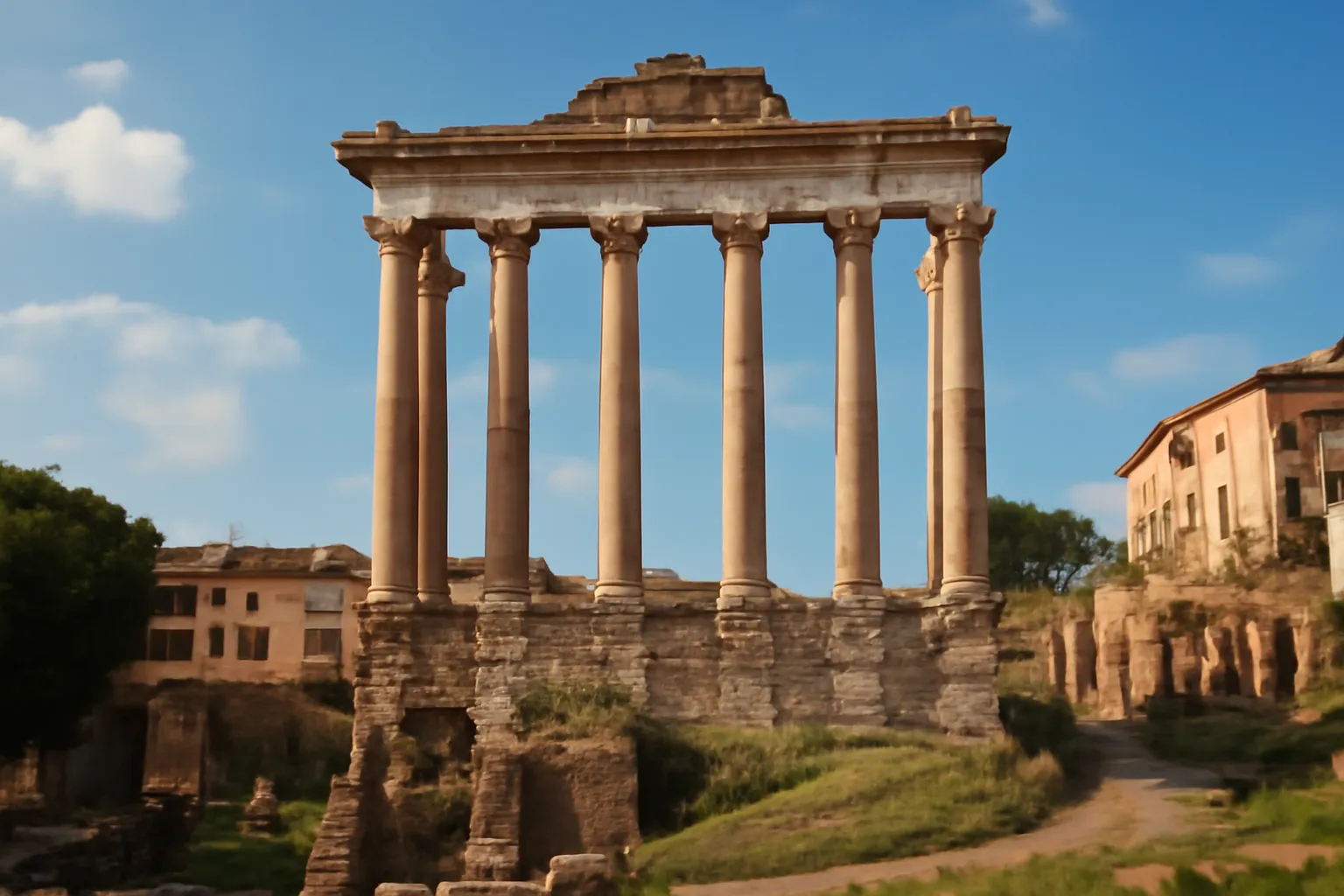
The physical remains of the Caesar temple are sparse, and much of what is known comes from ancient literary sources, later architectural reconstructions, and scattered inscriptions. Excavations in the Forum have uncovered fragments of marble, architectural modules, and occasional inscriptions that offer glimpses into the layout and decoration of this important shrine. These finds, though fragmentary, help scholars form an image of a grand monument designed to convey both sacred authority and political legitimacy.
The Significance of the Caesar Temple in Ancient Rome
The impact of the Temple of Julius Caesar extends beyond religious devotion. It functioned as a powerful symbol in a city where political legitimacy and divine sanction were deeply interwoven. By elevating Julius Caesar to the status of divus, the temple helped shape how Romans understood leadership, loyalty, and the state’s relationship with the gods.
Religious and civic roles
In religious terms, the shrine provided a formal space for worship of the deified founder and for rites associating the state with his memory. The cult of the Divus Julius would have included offerings, prayers, and possibly annual observances tied to the temple’s anniversary. From a civic perspective, the temple served as a venue where political leaders could anchor their authority in sacred tradition, linking the present to a revered past and presenting themselves as custodians of Rome’s enduring order.
Political symbolism and memory politics
The temple was a centerpiece in the early imperial project to recast republican authority in a framework acceptable to both traditional Romans and those who favored a centralized, autocratic system. The story of Caesar’s deification reinforced the idea that the state’s religious life enshrined the legitimacy of its rulers. For Octavian and later emperors, invoking the legacy of Caesar created a continuity narrative: they could claim to be heirs to Caesar’s political mission while guiding the Republic toward a new imperial configuration.
Impact on art, ritual, and law
The presence of a shrine to the deified founder influenced Roman art and law by creating a recognizable locus of memory. Statues, inscriptions, and ceremonial paraphernalia associated with the temple contributed to the visual vocabulary of the late Republic and early Empire. The religious calendar around the temple would have intersected with legal and political rituals, providing occasions for magistrates to demonstrate piety, loyalty, and administrative competence.
Long-term legacy in the Roman imagination
Even after Rome’s republican structures transformed under the early emperors, the temple dedicated to Julius Caesar remained a potent symbol in the city’s cultural memory. The idea of a divinized founder persisted in the public imagination, echoing in later imperial iconography, political rhetoric, and religious practice. For scholars today, the legacy of this shrine offers a window into how Romans conceptualized leadership, sacred authority, and memory across eras of upheaval and continuity.
Variations in naming and perception
In academic discussions, you will encounter several variations of the Julius Caesar temple to reflect its different facets. Terms such as the Temple of Julius Caesar, the Temple to the Divus Julius, the Caesar shrine, and the Temple of the Deified Julius all refer to the same monumental project while emphasizing distinct aspects: religious honor, political theology, or public commemoration. This plurality of names helps scholars map how Romans themselves varied their language to express a unified historical narrative.
Architectural Features and Design Principles
Although the precise floor plan of the Temple of Julius Caesar remains partly speculative, it is fruitful to consider the architectural language of the era. Monumental temples in ancient Rome typically employed durable materials (marble and stone), a clear axial orientation, and a dignified appearance designed to convey authority and sanctity.
What scholars infer about the design
The cellar or inner sanctuary would have housed the cult image and possibly a statue or bust of Divus Julius;
A formal peristyle or sanctified portico might have framed the entrance, with columns displaying a rhythm of rhythm and light;
Friezes, inscriptions, and sculptural programs would communicatively tie Caesar’s life to the present regime’s ideals;
The temple’s precinct could include altars for offerings and a space for public ritual activities that connected religious observation with political ceremonies.
Ornament and iconography
The iconography associated with the temple would likely reflect a synthesis of classical republican taste and early imperial grandeur. Statues, reliefs, and inscriptions highlighted a lineage from the republic’s heroes to the new order’s rulers, with Julius Caesar at the apex of a shared Roman memory.
Influence on subsequent sacred architecture
The practice of commemorating prominent leaders through dedicated shrines set a precedent that resonated beyond Caesar’s own time. The idea that a city could sanction a divine status for a founder or patron would echo in later imperial cults and sacred spaces, shaping both urban planning and religious life in Rome.
Why the Caesar Temple Matters for Understanding Ancient Rome
The Temple of Julius Caesar stands as a powerful reminder that Roman religion and political life were deeply interconnected. It demonstrates how Romans used sacred spaces to build memory, justify political continuity, and articulate visions of leadership. By studying the temple’s history, its possible location, and its significance, we gain a richer understanding of how public religion functioned as a theater for national identity, commemorative practice, and power.
In many ways, the Caesar shrine anticipated trends that would shape later centuries: the use of sacred architecture to stabilize political authority, the practice of deifying rulers as a means of legitimizing their policies, and the enduring importance of memory as a political resource. Its story invites us to consider how a city can be governed not only through laws and armies but also through temples, rites, and the memory of a single, transformative figure.
For readers seeking a cohesive narrative, remember the Temple to Julius Caesar is not merely an ancient building; it is a node in a vast network of religious ideology, urban identity, and political strategy. Whether described as the Temple of the Divus Julius, the Caesar temple, or the Temple dedicated to Julius Caesar, its presence in the Roman Forum continues to illuminate how the Romans imagined the relationship between mortal achievement, divine sanction, and the city’s future.