The name Baal evokes a spectrum of meanings across time, geography, and belief. In antiquity, Baal referred to a family of Canaanite and Levantine deities associated with weather, storms, fertility, and the agricultural cycle. In contemporary discourse, however, the term is used in multiple, sometimes divergent ways: as a subject of scholarly analysis about ancient religion, as a figure in literary and pop-cultural works, and, for a minority, as the focus of revived or reconstructed devotional practices. This article surveys the terrain of modern Baal interpretations and the ways people encounter, study, or even practice what is sometimes called Baal worship today. It aims to describe the landscape with nuance, acknowledging historical complexity while highlighting how present-day communities think about and relate to this ancient figure.
What follows is not an endorsement of any particular practice and does not suggest that there is a single, unified “Baal religion” today. Rather, it sketches the array of perspectives, scholarly debates, and contemporary expressions that scholars, students, and curious readers may encounter when they encounter Baal in the 21st century. Throughout, key terms are given emphasis to underscore their importance in current discussions: historical Baal, modern scholarship, neo-pagan and reconstructionist movements, occult currents, and cultural reception.
Historical background and contemporary reframing
The ancient Baal and its cultural milieu
In antiquity, Baal was a title used for various regional deities in the Levant and neighboring areas. The most famous figure associated with this name is Baal Hadad, sometimes simply referred to as Baal or as Hadad in different cultures, who embodied the forces of rain, storm, and fertility. Archaeologists and scriptural scholars have long emphasized that Baal worship was not a single, uniform system but a mosaic of local cults, priestly offices, and ritual practices. Temples, altars, festivals, and seasonal rites often reflected local topography, agricultural calendars, and political alliances. To many researchers, Baal represents a broader category of “weather gods” and fertility deities whose worship varied from city-state to city-state, and from one century to the next.
The biblical portrayal of Baal is frequently polemical, presenting Baal-worship as a competing allegiance to the God of Israel. Yet scholars today often stress historical complexity: biblical texts, while critical, also reveal how surrounding cultures perceived Baal as a legitimate religious presence. In studying historical Baal, researchers look not only at textual sources but also at iconography, dedications found in the archaeological record, and comparative religion approaches that illuminate how Baal-related beliefs intersected with other Near Eastern traditions.
When we speak of modern Baal interpretations, we are not reviving the exact ancient cult as it existed millennia ago. Rather, we are examining how contemporary people understand Baal as a symbol, a scholarly case study, and a cultural touchstone. The modern conversation often centers on three themes: precise historical reconstruction, symbolic and metaphorical readings of Baal in literature and media, and the emergence of new religious movements that explicitly or implicitly engage Baal as a deity or archetype.
From archaeology to allegory: two pathways in present-day discourse
Archaeological and philological inquiry: This path emphasizes the materiality of Baal cults, the diversity of local cults, and the ways in which Baal was worshiped within different political communities. Scholars compare hieroglyphic and cuneiform sources, inscriptions, temple layouts, and ritual jars to build a nuanced picture of Baal’s role in ancient society.
Literary and cultural studies: In this direction, Baal functions as a symbol—of power, nature, chaos, or renewal—within modern novels, films, games, and graphic narratives. The aim is not to recreate an ancient ritual but to understand how the Baal figure resonates with contemporary concerns such as weather anxiety, ecological upheaval, or the tension between tradition and modernization.
Modern perspectives on Baal
Scholarly viewpoints: how the academy treats Baal today
In modern scholarship, Baal is approached as a window into ancient Near Eastern religious life. Researchers emphasize several core ideas:
Plurality and regional variation: Baal was not a single “god” with one fixed set of attributes. The name and concept encompass a family of deities with distinctive local identities and cultic practices.
Ritual life and social order: Baal cults often connected agricultural cycles to political structures. Priesthoods, temple economies, and ritual calendars helped organize community life and resource distribution.
Interreligious dynamics: The interactions between Baal worshipers and adherents of the Israelite, Egyptian, and Mesopotamian religious worlds generated dialogue, competition, and exchange of ideas that shaped religious landscapes across centuries.
Symbolic readings: Beyond historical reconstruction, many scholars explore how Baal functions as a symbolic figure—representing storms, renewal, and the uncertainties of nature—and how those symbolic dimensions persist in modern imagery and discourse.
In contemporary academic circles, the language of “revival” is used cautiously. Most scholars would resist treating modern Baal devotion as a simple revival of an ancient cult. Instead, they recognize a continuum: the past informs present inquiry, while present interpretations inevitably reshuffle and reframe what Baal means to modern audiences.
Religious studies and the ethics of naming
Religious studies scholars often discuss the ethics and implications of naming practices in modern contexts. When people talk about the worship of Baal today, it is crucial to distinguish between academic description, personal devotion, and public rhetoric. Some modern groups may adopt Baal as part of a broader pantheon, while others use the term metaphorically to discuss power, weather, or cosmic forces. The field encourages careful language, explicit intent, and a clear delineation between scholarly analysis and personal belief or practice.
Contemporary expressions: where Baal appears in the present day
Neopagan and reconstructionist currents
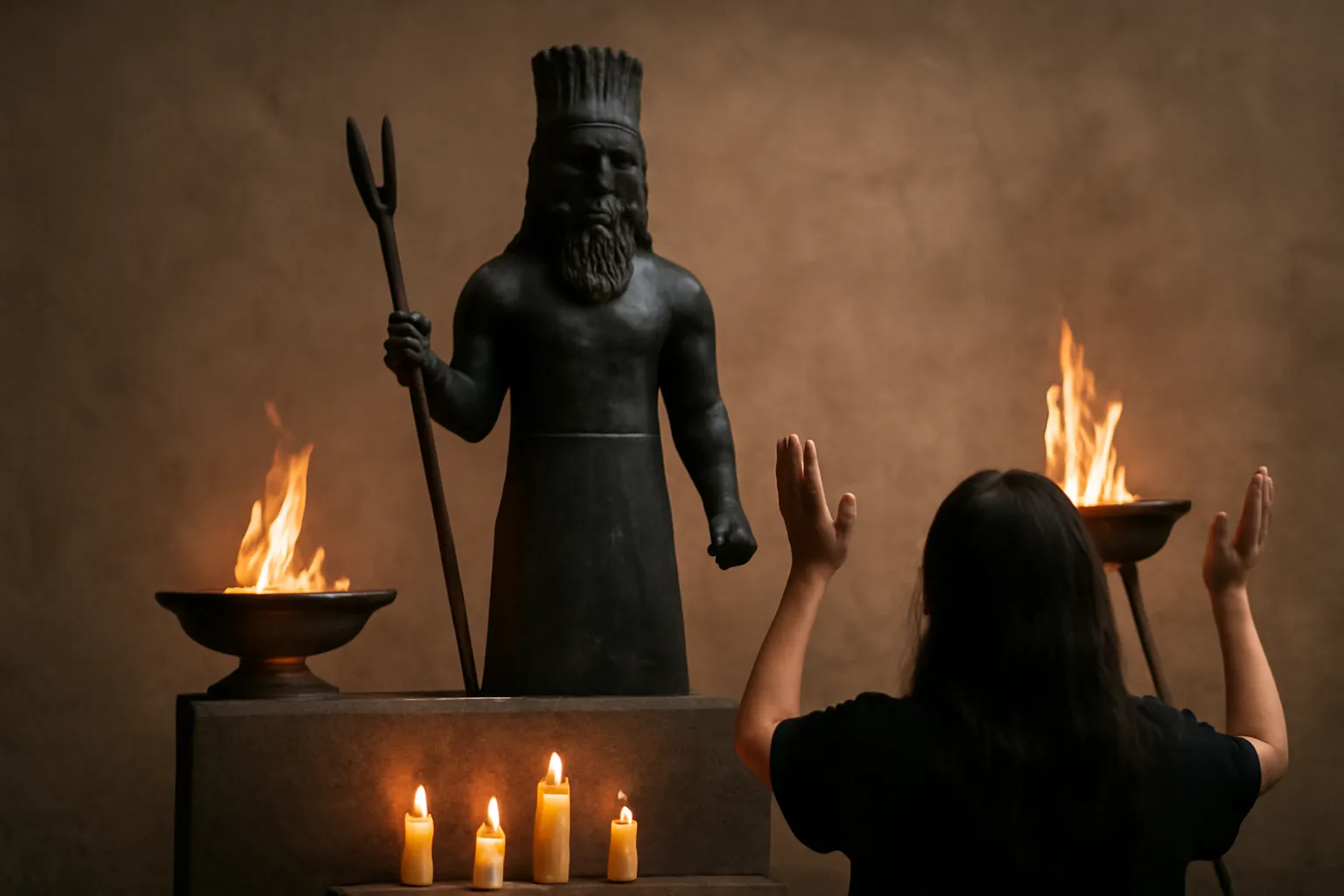
Within the broader neopagan and reconstructionist communities, there are groups that actively seek to reconstruct or reimagine ancient Near Eastern deities, including Baal. In these contexts, Baal may be invoked as a symbol of natural forces or as a household or seasonal deity tied to rain, harvest, or fertility. Some practical notes about this space:
Regional reconstructions: Small communities or solitary practitioners may focus on Baal Hadad or Baal as they interpret temple inscriptions and mythic texts. Their rituals, if conducted, often emphasize seasonal cycles, gratitude for rain, and agricultural blessing.
Ritual formats: Practices can include offerings, prayers, seasonal rites, and reflective meditation on the interplay between humanity and nature. These rituals are typically conducted privately or within small community groups, with an emphasis on consent, safety, and respect for diverse beliefs.
Eclectic or syncretic avenues: Some practitioners blend Baal concepts with other deities or with ethical frameworks that value ecological stewardship, community resilience, or social justice. This syncretism reflects contemporary values rather than a direct reconstruction of ancient cults.
For observers, it is important to distinguish reconstructionist Baal practices from sensationalized depictions in popular media. The former tends to foreground historical inquiry, ethical conduct, and scholarly sources, while the latter can lean into mythic drama without rigorous grounding.
Occult traditions and esoteric currents
A different stream of modern engagement with Baal appears within certain occult and esoteric communities. Some grimoires and occult lineages reference Baal as a figure of power, primarily in symbolic or ritual contexts. In these circles, Baal may be invoked as a symbol of mastery, transformation, or the harnessing of elemental forces. It is essential to approach this topic with caution:
Distinction between myth and practice: In occult literature, Baal may function as a symbolic or archetypal force rather than a literal deity requiring worship. Interpretations vary widely between groups.
Safety and ethics: Responsible practitioners emphasize ethical conduct, informed consent, and personal responsibility. The use of symbolic correspondences is generally framed within a moral and experiential context rather than coercive or harmful action.
Critical analysis: Scholars and informed readers keep in view the historical baggage around the name and its representations, avoiding misrepresentation of ancient beliefs as a direct template for modern practice.
Popular culture, fiction, and media representations
In novels, video games, graphic novels, and films, Baal surfaces as a potent symbol or character. These representations shape public imagination and sometimes prompt interest in the historical Baal as well as in broader themes such as power, weather, and divine authority. Readers and viewers should recognize that such depictions are often allegorical, sensational, or imaginative rather than documentary accounts of ancient worship. For some audiences, these portrayals spark curiosity that leads to constructive study in academic or spiritual contexts; for others, they reinforce archetypal tropes that may oversimplify the historical record.
Contemporary practices and expressions: how people engage with Baal today
Rituals, calendars, and devotional practices among practitioners
Where present, devotional practices around Baal today tend to be modest in scale and focused on reflection rather than spectacle. Common features across different groups might include:
Seasonal observances: Some communities mark the changing seasons with rituals that acknowledge Baal’s associations with rain, harvest, and renewal. These events may be small gatherings centered on gratitude for rainfall or agricultural abundance.
Offerings and prayers: In some settings, practitioners offer symbolic tokens, such as grains or water, and recite prayers or invocations that align with their understanding of Baal as a force of natural order and vitality.
Ethical and ecological themes: Modern Baal-adjacent practices frequently foreground stewardship of the Earth, communal responsibility, and a respectful relationship with the environment, aligning with contemporary ecological ethics.
It is important to emphasize that these practices are not standardized and vary widely by region, community, and individual belief. The absence of a centralized authority means that “Baal worship today” often looks different from one practitioner to another, with emphasis on personal meaning and consent within any group setting.
Worldview and theological contours
In contemporary discussions, Baal is rarely treated as a single, unified deity with a uniform theology. Instead, different thinkers emphasize:
Thematic flexibility: Baal embodies power, weather, fertility, and resilience in ways that can be repurposed to reflect modern concerns—such as climate resilience, economic stability, and community solidarity.
Historical humility: Many scholars and practitioners acknowledge the limitations of our sources and resist projecting modern agendas onto ancient beliefs.
Interfaith and intercultural dialogue: The Baal figure appears in conversations about religious plurality and interreligious exchange, illustrating how ancient identities still resonate in pluralistic modern societies.
Ethical, legal, and cultural considerations in contemporary Baal-related activity
Ethical considerations: respect, consent, and disclaimers
Thinking about Baal-related practices today invites careful ethical reflection. Because Baal is a historically sensitive figure tied to ancient religious expressions, modern practitioners—and scholars—should:
Respect the autonomy and beliefs of others, especially when participating in group rituals or public events.
Be transparent about intentions, sources, and influences to avoid misrepresenting ancient customs or exploiting historical contexts for political or sensational purposes.
Adhere to legal requirements and safety guidelines, particularly when rituals involve any form of community gathering, the handling of symbolic elements, or practices that may impact participants’ well-being.
Legal and safety considerations
Most individual and group activities connected with Baal symbolism remain within the boundaries of legal, peaceful religious practice. However, when ritual activity veers into activities that could be construed as coercive, exploitative, or harmful, legitimate concerns arise. Communities committed to responsible practice typically:
Uphold explicit consent among participants and provide opt-out options.
Promote non-harmful, non-coercive engagement and avoid any form of intimidation or pressure.
Seek guidance from reputable sources in religious studies, anthropology, and ethics to situate their practices within a broader, critically informed framework.
Criticism and controversy surrounding modern Baal discourse
Scholarly critique: caution against overgeneralization
One recurring theme in contemporary discourse is caution about treating Baal as a single, monolithic source of religious authority. Critics argue that:
“Baal” is a label with many geographic, linguistic, and historical layers, and modern use should reflect that complexity.
The tendency to sensationalize Baal in pop culture can obscure nuanced scholarly findings about ancient cults and religious life.
Reconstructionist efforts must be clearly distinguished from mythopoetic or literary readings to avoid conflating historical accuracy with symbolic reinterpretation.
Contemporary controversy and public discourse
In some public arenas, Baal has been invoked in ways that spark controversy. For example, when public discussions connect Baal to political ideologies or social movements, it may provoke misinterpretation or misrepresentation. Sensationalized portrayals in media can lead to misunderstandings about the historical record. Responsible engagement involves:
Relying on peer-reviewed scholarship and primary sources where possible.
Acknowledging the limits of our knowledge and avoiding definitive statements about ancient practices based on limited evidence.
Respectfully engaging with diverse viewpoints and avoiding cultural appropriation that disrespects living religious communities.
Why Baal remains a meaningful topic today
Symbolic resonance in the modern era
Even without a centralized modern Baal church or a single liturgy, the figure of Baal continues to resonate because it embodies universal themes:
Power and authority: Baal’s associations with weather and governance mirror enduring questions about leadership, legitimacy, and the accountability of those who wield power.
Nature’s volatility: The storms and rains linked to Baal speak to contemporary anxieties about climate, agriculture, and environmental stewardship.
Renewal and cycles: Baal’s seasonal connections invite reflection on cycles of death and rebirth, which can be meaningful in personal development and communal resilience.
Educational value for readers and students
For students of religion, history, archaeology, and literature, the modern discourse surrounding Baal offers a fertile case study in how ancient belief systems are interpreted, reimagined, and repurposed in new contexts. It demonstrates:
How scholarly interpretation evolves as new evidence emerges.
How cultural imagination shapes our understanding of the past.
How the interplay between myth, ritual, and symbol persists across millennia.
Baal in the present, a spectrum rather than a single path
The question of Baal worship today does not yield a single, definitive answer. Instead, it reveals a spectrum of engagement, ranging from careful historical study and cautious reconstruction to symbolic usage in literature and media, to small-scale, consent-based devotional practices that acknowledge Baal as a meaningful figure for some individuals and communities. The contemporary conversation about Baal is characterized by:
Historical humility: A recognition that our sources are fragmentary and that our reconstructions must be handled with care and scholarly integrity.
Ethical mindfulness: An emphasis on consent, safety, and respect for diverse religious sensibilities in any practice that touches on ancient deities.
Intellectual openness: A willingness to examine how ancient myths and deities can illuminate present concerns about weather, fertility, power, and renewal without erasing historical nuance.
For curious readers, exploring the modern conversations around Baal can be a gateway to broader inquiries: how ancient belief systems were embedded in material culture and social life, how modern identities incorporate or contest these legacies, and how the past continues to speak to contemporary questions about nature, authority, and meaning. Whether encountered as a scholarly subject, a literary symbol, or a living thread in a devotional tapestry, Baal remains a potent emblem for the enduring human attempt to understand the forces that shape life on earth.