The term Living Word Bible invites readers to see Scripture not as a static collection of ancient texts, but as a dynamic, life-giving conversation between God and people. In this comprehensive guide, we explore what the living Word means, trace its historical roots, and offer practical methods for reading, studying, and applying the Bible in daily life. Whether you encounter a Living Word Bible as a paraphrase, a translation, or a devotional edition, the core idea remains: God’s message speaks today as surely as it spoke in ancient times.
The phrase Living Word Bible can refer to several related concepts. At its broadest, it describes the Bible as God’s living speech to human beings. The term underscores the belief that Scripture is not merely an old book but a present reality that guides, convicts, comforts, and transforms. In many Christian traditions, the living Word is expressed through both the written Word (the biblical text) and the ongoing work of the Holy Spirit who illuminates and applies that Word in the reader’s life.
Scriptural authority: The Bible is considered authoritative for faith and practice, yet its authority is understood in relation to God’s ongoing communication with the church.
Dynamic reception: A living Word Bible invites readers to engage with the text in ways that produce personal change, community discernment, and social responsibility.
Spiritual illumination: Many traditions emphasize that the Holy Spirit helps readers understand, interpret, and apply Scripture in ways that are relevant to their context.
In this sense, the Living Word Bible is both a theological conviction and a practical approach to reading. It is a stance that Scripture continues to speak as you read, reflect, and respond. The term is also used for certain editions—such as study Bibles, devotional Bibles, or paraphrase translations—that aim to present the Word in a form that feels immediate and readable while preserving fidelity to the original message.
Historical Foundations: From Ancient Texts to a Living Story
To understand the living Word in today’s Bibles, it helps to situate Scripture within its long historical journey. The Bible comprises ancient texts written in different languages, compiled over centuries, and treasured in the Christian church. Its history informs how the Living Word is read in different communities today.
The Bible as a historical document and living tradition
Core elements of the Bible’s history include:
Prophetic and poetic beginnings in the Old Testament, where in many books the Word of God is spoken through prophets, sages, and psalmists.
Incarnational word in the New Testament, where the Word becomes flesh in Jesus Christ, often summarized as the Logos (John 1:1–14).
Canonical shaping as communities recognized authoritative writings to form a coherent witness about God’s redemptive work.
Transmission and translation through the centuries, culminating in modern Bible translations, study aids, and devotionals that help contemporary readers access the text with clarity.
Within church history, debates about how to interpret the Bible—its genres, historical contexts, and theological aims—shaped how the living Word is understood today. The Protestant Reformation, for example, emphasized Scripture’s accessible authority in the vernacular, while the Catholic and Orthodox traditions have long integrated Scripture with tradition, liturgy, and the guidance of the Church’s teaching authority. Across these streams, the enduring claim remains: Scripture is God’s living speech that continues to form, inform, and reform believers across generations.
Translation, paraphrase, and the question of accessibility
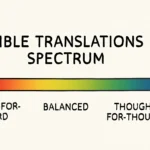
Over the centuries, many approaches have been taken to present the biblical message in languages and idioms that speak to readers today. Key forms include:
Word-for-word translations (formal equivalence) that aim to stay close to the original wording and structure.
Thought-for-thought translations (dynamic equivalence) that prioritize readability and contemporary expression while conveying the intended meaning.
Paraphrase editions that rephrase the text in plain language for modern readers, sometimes offering fresh phrasing to illuminate familiar passages.
Study and devotional Bibles that pair the text with notes, maps, and reflections designed to aid a living encounter with the Word.
The Living Word Bible family often includes paraphrase and devotional formats, which aim to help readers encounter the text in a way that feels immediate and personal. At the same time, traditional translations remind readers to ground their understanding in the original languages and historical contexts. The living Word is best approached with both reverence for ancient sources and openness to fresh insight in today’s world.
How to Read the Living Word Bible: A Practical Guide
Reading the Living Word Bible effectively involves more than simply moving from cover to cover. It invites a rhythm of attention, reflection, and application. The following steps outline a practical approach that can be used across editions—from the classic Living Bible paraphrase to today’s study Bibles and devotional variants.
Step-by-step approach to reading
Prepare your heart and space for encounter. Begin with a short prayer or moment of silence to invite illumination.
Choose a passage and a purpose. Decide what you want to learn, know, or apply in your life—daily guidance, a specific question, or a character study.
Read slowly and thoughtfully. In paraphrase editions, read aloud or aloud with others to hear the message; in more literal translations, pay attention to wording and nuance.
Observe and note. What stands out? What seems relevant to your life today? Mark words that recur, questions that arise, and promises to claim.
Interpret in context. Consider the historical, cultural, and literary context. How would the original audience have understood it? What is the broader biblical witness on this topic?
Apply to life. Identify concrete actions, attitudes, or changes in thought that follow from the passage.
Pray and reflect. Speak to God about what you’ve learned, and invite the Holy Spirit to shape your next steps.
Discuss and learn. Engage with a community—study group, sermon, or mentor—to hear other perspectives and grow in understanding.
In practice, you might use a SOAP method (Scripture, Observation, Application, Prayer) or a Lectio Divina approach (read, meditate, pray, contemplate). The goal is not merely to accumulate facts, but to experience a living engagement with God through the text.
Tips for reading a Living Word edition effectively
Use cross-references to see how a passage fits with broader biblical themes.
Pay attention to literary devices—metaphor, parallelism, poetry, and narrative structure reveal depth beyond plain prose.
Take notes in margins or a journal to track insights, questions, and personal applications.
Compare translations when a passage is ambiguous or difficult. Paraphrase editions can be helpful for initial exposure, but consulting a more literal translation for study can deepen understanding.
Read with others to test interpretations, gain new angles, and encourage accountability in applying the Word.
Study Aids and Resources for the Living Word
To engage deeply with the living Word, many readers rely on a range of tools designed to illuminate meaning, history, and application. These resources can be used in combination with any Living Word Bible edition.
Common study aids
Commentaries offer explanations of historical context, language nuances, and theological interpretation.
Concordances help locate themes, phrases, and key words across the scriptural corpus.
Dictionaries and encyclopedias provide background on people, places, customs, and culture referenced in the text.
Maps and timelines give spatial and chronological context to biblical events.
Interlinear Bibles display the original Hebrew, Aramaic, and Greek texts aligned with a translation.
Devotional guides pair daily readings with reflections, prayers, and prompts for action.
When using these tools, aim for a balanced approach: let the text lead, and use aids to clarify, not to replace, your encounter with Scripture.
Variations of the Living Word Bible: Editions, Translations, and Formats
Over time, publishers have produced many formats under the umbrella of Living Word concepts. Here are some common varieties you may encounter, each with its own strengths for different readers and contexts.
Paraphrase editions
Readability-first editions that prioritize natural language and accessibility over strict literal accuracy.
Devotional-friendly formats designed for daily reading with practical applications and reflections.
Narrative-driven renderings that emphasize storytelling and the human dimension of Scripture.
Study Bibles and reference editions
Extensive notes explaining historical background, theological themes, and cross-references.
Features for interpretation such as word studies, charts, and theological themes that illuminate how the Word interacts with life.
Topical and book-specific guides to help readers undertake systematic study across a book or topic.
Traditional translations and modern equivalents
Formal-equivalence translations (word-for-word) for precise study of original languages.
Dynamic-equivalence translations (thought-for-thought) for readability and contemporary understanding.
Contemporary paraphrases that aim to capture freshness of language and everyday speech while preserving overall meaning.
Theological and interpretive dimensions of the Living Word
Reading a Living Word Bible carries theological implications about how God communicates, how humans understand, and how faith communities respond. Here are some key ideas that frequently surface in discussions about the living Word.
God speaks through Scripture and Spirit
A central belief is that God communicates through the written Word and confirms understanding through the Holy Spirit. This dual channel—text plus Spirit—helps believers discern truth and apply it faithfully. Some readers emphasize personal illumination, while others highlight communal discernment through preaching, teaching, and the witness of the church.
Context, canon, and interpretation
Interpreting the living Word responsibly requires attention to context—historical setting, literary genre, and the broader canonical witness. Readers are encouraged to consider questions such as:
What did the author intend to communicate to the original audience?
What issue or situation prompted the writing?
How does the passage fit with the overarching story of the Bible?
What in today’s world might God be calling readers to change as a result of this passage?
Healthy engagement with the Word avoids simplistic proof-texting and seeks to understand Scripture within the life of faith, community, and mission.
Unity and diversity in interpretation
The concept of the living Word welcomes a range of legitimate perspectives while remaining anchored in core doctrinal anchors. Different Christian traditions may emphasize varying interpretive emphases—prophetic revelation, incarnational ethics, or sacramental life—yet all are invited to approach the text with humility, curiosity, and obedience.
The Living Word Bible can serve many purposes—from quiet time to scholarly study. Depending on your goal, you might adopt different strategies.
Devotional reading
Focus on a short passage, a single verse, or a thematic strand.
Pair the reading with prayer, meditation, and a practical application for the day.
Choose editions that include reflective prompts and devotional commentary.
In-depth study
Work with a study Bible or a commentary to explore linguistic notes and historical context.
Engage phrase-by-phrase analysis and consider multiple translations for clarity.
Compile a personal set of observations and questions for discussion in a group.
Group study and teaching
Use a common translation and agreed-upon methodology to facilitate discussion.
Encourage diverse viewpoints and model respectful dialogue about interpretation.
Apply the Word to current issues with care, guiding participants toward compassionate action.
Readers of the Living Word Bible edition should be aware of common missteps that can hinder honest engagement with Scripture.
Proof-texting: Pulling a single verse out of context to prove a point without considering surrounding material.
Literalism without nuance: Treating poetic or metaphorical language as a literal scientific statement.
Reading in a vacuum: Ignoring historical and cultural background that shapes meaning.
Overconfidence: Assuming one’s initial interpretation is the final word without consulting others.
Selective application: Emphasizing one aspect of a passage while neglecting broader ethical implications.
Healthy practice involves humility, curiosity, and a willingness to revise understandings in light of better evidence and communal discernment.
When readers engage the living Word with sincerity, it tends to produce transformation—personal renewal, strengthened relationships, and a deeper sense of mission. The impact can appear in several dimensions:
Character formation: Virtues such as patience, mercy, generosity, and integrity often take root in response to Scripture’s call to love and live justly.
Wise decision-making: The Word informs ethics, discernment, and practical choices in workplace, family, and community life.
Hope and resilience: The biblical narrative offers a framework for understanding suffering, redemption, and ultimate meaning.
Communal identity: Shared engagement with the Word strengthens bonds within a faith community and clarifies its mission.
Different readers will experience the living Word in distinctive ways, but the through-line is clear: Scripture is not only informative; it is transformative when read with openness to God’s ongoing work in the present.
Whether you are just starting your journey with the Living Word Bible or you have years of experience, these practical tips can help you stay engaged and growing.
For beginners
Start with a readable edition that includes devotional aids and clear introductions to each book.
Set a realistic pace—15–20 minutes per day can yield steady, meaningful progress.
Join a study group or partner with a friend to discuss insights and questions.
For experienced readers
Delve into original-language notes or interlinear resources to deepen your understanding of nuance.
Practice cross-book analysis to trace themes and motifs across the Bible’s arc.
Engage with scholarly perspectives while maintaining a primary focus on personal application and spiritual growth.
In the end, the idea of the living Word invites readers to enter into a lifelong conversation with God through Scripture. A Living Word Bible is not merely a text to be studied; it is a prompt to be lived. It asks readers to listen, reflect, and act in ways that honor the source of life and truth. As you explore this compound of ancient wisdom and contemporary relevance, your understanding may broaden, your heart may soften, and your life may align more closely with the kind of love and justice that Scripture consistently points toward.
If you would like to explore further, here are some practical resources and next steps that can support your journey with the living Word:
Devotional plans that pair daily readings with reflective prompts and prayers.
Commentaries and lexicons to deepen your understanding of difficult passages.
Online study communities and local church study groups for shared learning and accountability.
Comparative translation guides to discern how different renderings illuminate or nuance a passage.
As you move forward, remember that the living Word is a gift intended to illuminate your mind, shape your heart, and mobilize your hands for service. No single edition has all the answers, but every edition—whether it’s a classic Living Bible, a modern dynamic-equivalence translation, or a thoughtful study edition—can contribute to a richer, more robust encounter with God’s message. May your journey with the Living Word Bible be marked by curiosity, humility, and growth, as you learn to hear what God is saying to you today and tomorrow.