Most Accurate English Bible Translation: A Comprehensive Guide
The question of which English Bible translation is most accurate does not have a single, simple answer. In the world of biblical studies, “accuracy” can mean different things depending on the purpose: fidelity to the original languages, reliance on the best available manuscripts, readable English, or usefulness for study, teaching, or liturgy. This guide offers a thorough exploration of what makes a translation accurate, how major English translations differ in philosophy and textual basis, and practical guidance for choosing the best version for your needs. Throughout, we will reference the common terms you will encounter in scholarly discussion, such as formal equivalence, dynamic equivalence, and critical text, and we will provide concrete recommendations for different use cases.
How to think about accuracy in Bible translations
To evaluate accuracy, it helps to separate several related but distinct concerns. Broadly speaking, a translation can be accurate in the following senses:
Textual fidelity: How faithfully the translation renders the wording of the underlying Hebrew, Aramaic, and Greek texts.
Manuscript basis: Whether the translation relies on the most critical, up-to-date manuscript evidence (e.g., UBS/Nestle-Aland for the New Testament, BHS or equivalent for the Old Testament) vs older or less comprehensive bases.
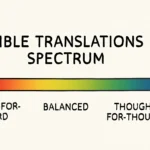
Translation philosophy: Whether the translators favor a strictly word-for-word approach (formal equivalence) or a more thought-for-thought approach (dynamic equivalence). Each approach has trade-offs for accuracy and readability.
Editorial and textual notes: The presence and usefulness of translator notes, alternative renderings, and cross-references that reveal difficult decisions or contested readings.
Consistency and transparency: How consistently the translation handles key terms (e.g., divine names, covenant terminology) and how transparently it communicates uncertainties or textual variants.
Because these criteria pull in different directions, there is not a universal “most accurate” translation for every reader. Instead, there are translations that excel in particular domains, and there are translation projects designed to fill gaps in others. The goal of this guide is to map those strengths and help you match a translation to your needs.
Key concepts that shape accuracy
Formal equivalence vs. dynamic equivalence
Two broad philosophies shape English Bible translations:
Formal equivalence (word-for-word): Aims to reproduce as closely as possible the wording and syntax of the original languages. This often yields greater fidelity to the source text but can be harder to read. Examples of translations leaning toward formal equivalence include the New American Standard Bible (NASB), the English Standard Version (ESV), and the classic King James Version (KJV).
Dynamic equivalence (thought-for-thought): Prioritizes conveying the meaning in idiomatic English, sometimes at the expense of literal wording. This can improve readability and comprehension, especially for contemporary readers. Examples include the New International Version (NIV) and the New Living Translation (NLT).
There is also a middle ground often described as optimal equivalence or hybrid approaches, attempting to balance accuracy with readability. The Christian Standard Bible (CSB) and the newer Holman Christian Standard Bible (HCSB) represent this middle path. When assessing a translation’s accuracy, it can be helpful to ask:
Does the translation preserve the most important terms (e.g., names, key theological concepts) consistently?
Are the most difficult phrases rendered with care, with notes explaining uncertain readings where appropriate?
Is the grammar and syntax of the original text represented in a way that makes sense to modern readers without distorting the original sense?
Textual bases and textual criticism
The textual basis refers to the manuscript evidence that underpins a translation. In the Old Testament, standard scholarly practice uses editions such as the Massoretic Text (MT) or critical editions with notes on variant readings. In the New Testament, translators rely on critical editions such as the Nestle-Aland and UBS texts, which are built from the best available manuscripts, including early papyri and uncials. Some traditional translations rely more on the Textus Receptus (TR) or other later witnesses, which has implications for certain readings.
Translators who emphasize critical text generally aim to present readings most supported by earliest and most authoritative manuscripts, with editorial notes that reveal where readings diverge. Translations anchored to a broader or older textual base are not inherently superior in all cases, but they often encounter more contested passages and may provide more extensive textual apparatus for readers seeking to study the evidence.
The major English translations and what makes them notable for accuracy
Below is an overview of several widely used English Bible translations, focusing on their approach to accuracy, manuscript bases, and typical use cases. This is not an exhaustive list, but it highlights the translations most often discussed in scholarly and theological contexts.
New American Standard Bible (NASB) — fidelity and precision
The NASB has a long-standing reputation for high literal fidelity to the original languages. Its 1995 revision and the more recent NASB updates strive to preserve precise terminology and syntax, often at the expense of readability. The NASB is heavily used in scholarly study and sermon preparation when readers want a translation that stays close to the wording of the Hebrew and Greek texts.
Textual basis: OT based on the Masoretic Text; NT aligned with critical Greek texts (UBS/Nestle-Aland family).
Strengths: Very close to the original wording; clear translation of grammatical nuance; strong apparatus for textual decisions in notes (where included).
Limitations: Sometimes reads stiffly; less idiomatic English than some other translations; may require additional study notes for clarity in certain passages.
For readers who want a “most accurate” rendering in terms of word-for-word precision, the NASB remains a top contender, especially in study contexts where precise wording matters for exegesis and cross-reference work.
English Standard Version (ESV) — balance of precision and readability
The ESV is often described as a formal-equivalence translation with modern readability. First published in 2001 and revised in 2001–2011, the ESV aims to preserve idiomatic accuracy without sacrificing the underlying sense. It is widely used in academic settings, preaching, and personal study, admired for its consistency and careful handling of textual variants.
Textual basis: OT primarily MT-based with notes; NT primarily critical Greek text (UBS/NA).
Strengths: Smooth, readable English that retains close ties to the source text; suitable for in-depth study and public reading.
Limitations: Some readers may encounter occasional archaic phrasing or interpretive choices in difficult verses.
Accuracy in the ESV is often highlighted in its commitment to retaining original terms where possible, while refining syntax to align with contemporary English usage.
New Revised Standard Version (NRSV) — scholarly reliability and inclusivity
The NRSV is a cornerstone of modern biblical scholarship in many academic and liturgical contexts. Published in 1989, with updates and revisions, it uses a critical text approach for the New Testament and is noted for its careful treatment of gender-inclusive language where appropriate, while maintaining fidelity to the Greek and Hebrew texts.
Textual basis: MT for the OT, critical texts for the NT; extensive scholarly apparatus and notes.
Strengths: Excellent usefulness for study, interpretation, and cross-cultural scholarship; widely accepted in academia and among many denominations.
Limitations: Some readers may prefer a more literal rendering or a more modern phrasing in places; inclusive language decisions can be debated by different readers.
Readers seeking a translation with strong scholarly grounding and a robust set of notes will often turn to the NRSV for research and teaching.
New International Version (NIV) — readability with broad appeal
The NIV is a classic example of dynamic equivalence, prioritizing accessible English while preserving the essential meaning of the original text. First published in the 1970s and updated in 1984, 2005, and 2011, the NIV has become a staple for personal devotion, youth ministries, and many churches seeking comprehensible scripture without sacrificing core doctrine.
Textual basis: Uses a critical Greek text for the NT and MT for the OT, with notes guiding readers through textual issues.
Strengths: Excellent readability; widely used in public services and study groups; broad denominational acceptance.
Limitations: Some readers feel that the dynamic approach sacrifices some precision; fewer explicit textual notes than some more literal translations.
For those prioritizing ease of reading in daily life or small groups, the NIV remains a reliable choice, though readers who want precise wording for exegesis may supplement with more literal translations.
Christian Standard Bible (CSB) and Holman Standard Bible family — modern optimal equivalence
The CSB (and its predecessor HCSB) represents a contemporary attempt to combine accuracy with readability by employing an optimal equivalence philosophy. The CSB aims to be transparent about choices while keeping natural English flow, making it a popular option for churches and study alike.
Textual basis: OT MT with scholarly notes; NT based on critical Greek texts (Nestle-Aland/UBS).
Strengths: Clear and natural English without sacrificing important textual distinctions; useful translator notes illuminate choices on tricky passages.
Limitations: As a newer translation, some readers may still be acclimating to its renderings in certain verses.
For readers who want a balanced approach that remains faithful to original terms while offering contemporary readability, the CSB provides a compelling option.
New English Translation (NET Bible) — transparency and depth
The NET Bible distinguishes itself with an extensive set of translator notes and commentary integrated into the text. Although it uses a dynamic-equivalence leaning approach in many places, its hallmark is transparency—the notes reveal the textual decisions and variations that scholars debate.
Textual basis: Modern critical texts for NT and MT-based for OT, with robust notes explaining variants.
Strengths: A treasure trove for scholars and serious students who want to see the underlying choices; helpful for understanding textual criticism in real time.
Limitations: The abundance of notes can be overwhelming for casual readers; some prefer a more streamlined text for devotional reading.
If your goal is deep study and textual curiosity, the NET Bible’s notes are a major asset that can illuminate why a translation renders a passage the way it does.
King James Version (KJV) and the legacy of English Bible translation
The KJV remains a foundational English Bible whose textual history and literary influence are unparalleled. It relies on a combination of the Textus Receptus for the NT and the Masoretic Text for the OT, followed by centuries of English language development. While not the most up-to-date in terms of manuscript bases, the KJV is revered for its majestic cadence and enduring cultural impact.
Textual basis: TR for NT, MT for OT; later revisions have attempted to clarify some readings, but it does not reflect the same breadth of early manuscripts used by modern critical editions.
Strengths: Consistent, poetic English; strong theological and liturgical tradition; widely quoted in literature and worship.
Limitations: Some archaic language and readings that differ from modern critical editions; not ideal for technical exegesis without consultation of modern notes.
For many readers, the KJV is not a candidate for the most accurate English Bible translation in the strict sense of textual criticism, but it remains an invaluable cultural and devotional resource whose influence continues to shape English-language religion and scholarship.
Catholic and other traditioned translations
Several communities rely on translations produced within a particular tradition, incorporating deuterocanonical books and specific liturgical needs. Examples include the NABRE (New American Bible Revised Edition) and the NAB family used widely in Catholic liturgy. These translations are accurate within their canonical scope and reflect the theological priorities of their communities. They often include extensive introductions, notes, and textual apparatus tailored for readers within that tradition.
Textual basis: Combines MT with broader textual considerations for deuterocanonical books; uses Catholic scholarly resources.
Strengths: Strong alignment with Catholic tradition, meaningful liturgical integration, helpful notes on canonical context.
Limitations: Not always synchronized with Protestant-critical editions on every variant; best used within its intended ecumenical framework.
Which translation is the most accurate for a given purpose?
Because “accuracy” depends on purpose, you may prefer different translations for different activities. Here are practical guidelines based on common goals:
For close, word-for-word study and precise exegesis
NASB (especially NASB 1995 or NASB 2020): strong literal rendering; excellent for detailed word studies and alignment with original language grammar.
ESV: maintains a high degree of literal fidelity while improving readability; dependable for precise study and cross-referencing.
RSV/NRSV (and to a degree the NET Bible): good for scholarly work; transparent about textual decisions via notes and apparatus.
In academic settings, many scholars cross-reference multiple translations to triangulate readings and to understand how different renderings reflect textual choices.
For accessible reading, devotion, and public worship
NIV and CSB are excellent for readability and natural flow, which can facilitate comprehension in group settings and daily devotional reading.
NLT is highly readable for general audiences who want smooth, contemporary English, though it is more paraphrase-like than strictly literal.
Public worship and teaching often benefit from translations that balance clarity with fidelity, such as the CSB or ESV, depending on the tradition and audience.
For scholarly notes and textual transparency
NET Bible with its extensive translator notes is particularly valuable for readers who want access to the scholarly reasoning behind readings and textual variants.
NRSV with notes is widely used in academic contexts for its textual apparatus and critical scholarship.
In contexts where you want both readability and access to scholarly reasoning, using a main translation (e.g., ESV or CSB) alongside NET notes or NRSV notes can be an effective approach.
Practical tips for using the most accurate English Bible translation effectively
Even the most carefully crafted translation can be used more effectively with thoughtful reading strategies. Consider the following:
Compare multiple translations for the same passage. Reading a verse side by side in NASB, ESV, and NIV can reveal how translators render difficult phrases and why. This helps you discern nuance and avoid misinterpretation.
Consult translator notes and textual apparatus when you encounter a verse with a contested reading. Translations like the NET Bible and NRSV often provide notes that illuminate choices and alternatives.
Use a study Bible or concordance to explore key terms, linguistic roots, and semantic ranges. This deepens your understanding of how a verse functions within its original context.
Consider your purpose: choose a primary translation for your main use (study, memorization, or public reading) and keep a secondary translation for cross-checking tricky passages.
Common myths about “the most accurate translation” and the reality
There are several popular misconceptions about biblical translation accuracy. Here are a few and what the scholarly consensus tends to say:
Myth: “The most accurate Bible is the one with the most literal translation.” Reality: Accuracy depends on the purpose; strict literalness can hinder understanding of idioms and cultural context. A balanced approach often serves readers best.
Myth: “Newer translations are always more accurate.” Reality: Recency is not a guarantee of accuracy. What matters is the quality of the manuscript base, the translation philosophy, and the transparency of notes.
Myth: “All modern translations are equally reliable.” Reality: They differ in textual basis and philosophy; the most reliable choice depends on the user’s aims, not a blanket label.
How to evaluate an English Bible translation for yourself
Check the textual notes: Do you see notes that explain key textual choices? Are variant readings acknowledged?
Examine the translator’s philosophy: Is the translation named as formal, dynamic, or optimal? Does the approach align with your needs?
Look at cross-references and margins: Helpful translations provide cross-references, footnotes, and margin notes that illuminate decisions.
Assess the readability: Is the English suited to your reading level? Does the translation allow you to grasp theological terms and narrative flow?
finding the right balance in the search for accuracy
In the realm of Most Accurate English Bible Translation, there is no single ultimate answer. The most accurate translation depends on what you intend to do with the text. For rigorous scholarly exegesis, translations like NASB, ESV, and NRSV are excellent choices because they emphasize textual fidelity and robust editorial notes. For devotional and pastoral use, translations such as the NIV and CSB offer readable, reliable renderings that help readers connect with the biblical message without getting lost in linguistic complexity. For readers who value textual transparency and want to explore decision points in depth, the NET Bible provides a wealth of notes and commentary integrated into the text.
Ultimately, the most accurate English Bible translation is the one that serves your study, worship, and growth while staying faithful to the underlying languages and manuscripts. The best practice is often to engage more than one translation, consult notes, and cultivate an awareness of how translation choices shape interpretation. By approaching translations with thoughtful humility and critical curiosity, you can approach the Bible with greater clarity, confidence, and reverence.
Supplementary resources for deeper study
Study Bibles: A study Bible that includes maps, word studies, and textual notes can provide essential context for understanding translation choices.
Textual apparatus: For readers who want to delve into variant readings, consult the textual apparatus in editions like the Nestle-Aland/UBS or the apparatus included in critical editions mentioned by the translators.
Lexicons and concordances: Tools such as Strong’s Concordance and Hebrew/Greek lexicons enhance understanding of original-language terms and their semantic ranges.
Peer resources: Scholarly articles, apologetics resources, and denominational guidance can help you interpret readings in line with your community’s tradition while staying engaged with current scholarship.
In summary, the pursuit of the most accurate English Bible translation is a nuanced journey. By understanding the distinct aims of major translations, recognizing the importance of textual bases, and applying thoughtful reading strategies, you can select translations that best serve your personal study and the needs of your community. This comprehensive guide aims to empower you to make informed choices, appreciate the diversity of translation work, and engage with the biblical text in a way that is accurate, meaningful, and enriching.
What is a word-for-word translation? How it is defined in Bible study A word-for-word translation refers to a method of rendering biblical texts by prioritizing a close correspondence to the original wording, grammar, and syntax of the source languages (primarily Hebrew, Aramaic, and Greek) into the target language. In practice, this means that translators aim…
Care One King James: An Overview Care One King James, also referred to as CareOne King James, Care One: King James, or simply the King James care solution, represents a holistic approach to care management designed for modern health and elder-care environments. This guide aims to be a complete guide to the platform or program…
Genesis Translator refers to any approach, tool, or method used to render the opening book of the Bible from its original languages into another language with precision. This article explores how a Genesis translator can achieve accuracy, how the task differs from translating other biblical books, and what readers and scholars should expect from modern…