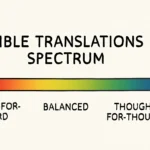
English renderings of the Tanakh—the canonical collection of Hebrew scriptures cherished in Jewish tradition—form a bridge between ancient texts and modern readers. Jewish Bible English is not a single, monolithic translation but a family of renderings, each shaped by its editors’ aims, textual bases, and communal contexts. Whether you are a student, a congregant, a translator, or a curious reader, understanding the landscape of Tanakh translations helps you read with awareness of the choices behind the words you encounter in English.
By Jewish Bible English we mean English translations that are produced primarily for Jewish communities or that consciously address Jewish readers and liturgical life. These translations often emphasize fidelity to the Masoretic Text, the traditional Hebrew text that underpins most modern Jewish editions. They also tend to reflect Jewish linguistic sensibilities, lectionary structures, and interpretive traditions, including notes on rabbinic interpretation, textual variants, and occasional liturgical considerations. Some translators aim for a literal or formal rendering that preserves Hebrew syntax and terminology, while others favor a more dynamic approach to convey nuance and poetry in English.
Anatomy of the Tanakh and its English Names
The Tanakh is divided into three major parts, and the way English editions present this structure can influence reading and study:
Torah (the Five Books of Moses) — the foundational narrative and legal corpus.
Nevi’im (the Prophets) — historical narratives, prophetic oracles, and the shaping of Israel’s identity.
Ketuvim (the Writings) — a diverse collection including poetry, wisdom literature, and miscellany.
Different English translations may preserve the traditional Hebrew order (Torah, Nevi’im, Ketuvim) or adopt alternate arrangements in study editions. Some translations also present named sections such as the Parashah (weekly portions) and the Haftarah readings in liturgical contexts, with notes to help readers connect English texts to the weekly cycle and to rabbinic interpretation.
A Brief History of English Tanakh Translations for Jewish Readers
The history of Tanakh translations in English reflects evolving aims, communities, and scholarly tools. Some pivotal moments and trends include:
Early 20th century: A push for a Jewish-centered English translation that accurately reflected Hebrew grammar and Jewish exegetical traditions led to the emergence of the classic editions later known as the JPS Tanakh family. These translations sought to provide authoritative English renderings while keeping a strong connection to rabbinic scholarship.
Mid- to late 20th century: Diverse publishers produced editions for different Jewish streams—Conservative, Orthodox, and Reform—each with its own translation philosophy, apparatus, and layout. The aim was to support study, prayer, and education within respective communities, often pairing the text with commentary and notes tailored to their theological commitments.
Late 20th to early 21st century: New interlinear and study editions appeared, offering English text alongside the Hebrew and robust notes. These volumes responded to a growing appetite for close Hebrew-English study, cross-referencing, and linguistic insight, while still honoring the reading practices of Jews around the world.
As a result, a broad spectrum of editions exists today, each with distinct strengths. The following sections outline the major families and their distinctive aims, so readers can choose translations that align with their scholarly needs or liturgical preferences.
Major Jewish English Translations
JPS Tanakh: The Jewish Publication Society’s Classic and Modern Revisions
The JPS Tanakh stands as a foundational translation in many Jewish communities. Its first major English edition, published in the early 20th century, sought to provide a text that was accurate, readable, and faithful to the Masoretic tradition while reflecting Jewish interpretive sensibilities. Subsequent revisions sought to refine language, update scholarship, and improve readability for contemporary audiences. Key features typically include:
Strong alignment with the Masoretic Text as the textual basis, with careful attention to Hebrew grammar and syntax.
Clear, formal English that aims to maintain biblical cadence without compromising intelligibility in modern usage.
Notes and introductions that situate the biblical books within Jewish history, liturgy, and rabbinic interpretation.
Appendices showing textual variants and cross-references to related Jewish sources.
Readers who want a precise, scholarly English rendering—one that is deeply anchored in traditional Hebrew text—often turn to the JPS Tanakh. It is widely used in Conservative and Reform Jewish contexts and has influenced many later Jewish editions in English.
In the mid-20th century, other Jewish English translations gained traction among readers seeking accessible English renderings with helpful commentary. The Soncino edition, for example, paired a translation with traditional rabbinic and modern scholarly notes, bridging classic Jewish interpretation with a readable English text. Characteristics often associated with such editions include:
Balanced translation that often renders difficult Hebrew idioms with careful English equivalents.
Editorial apparatus that highlights interpretive issues, textual variants, and cross-references to rabbinic sources.
Layout designed for study and education, sometimes featuring Chumash-style introductions and pericopes that map the weekly readings.
Though not as ubiquitous today as the JPS editions, classic translations like Soncino remain a historical touchstone for understanding how Jewish translators approached English renderings in the 20th century.
Artscroll Tanach and the Stone Edition
In Orthodox and traditional communities, Artscroll has produced some of the most popular English-language Tanakh editions. The Stone Edition Tanach (and related volumes) is known for:
A user-friendly English translation paired with the Hebrew text, intended to support private study and synagogue use.
Extensive commentary, notes, and rabbinic explanations that illuminate Jewish law, liturgy, and midrashic interpretations.
A careful typographic design that facilitates reading in both study and worship settings.
The Artscroll line emphasizes accessible English, with translation choices that reflect Orthodox Jewish practice and traditional readings, while still inviting readers to consider the text within broader Jewish interpretive frameworks.
Koren Tanakh and Contemporary Jewish Translations
More recently, publishers like Koren have sought to deliver modern, precise translations that balance fidelity to the Hebrew with readability in 21st-century English. The Koren Tanakh often features:
Fresh, accurate translations grounded in careful scholarship and a modern sensibility toward language.
Elegant typography and typography-friendly layout designed for both study and liturgical use.
Notes and commentary that integrate traditional rabbinic interpretation with contemporary linguistic insights.
The Koren edition appeals to readers who want a sleek, highly readable English rendering that remains faithful to the Hebrew text and is suitable for devotional reading, classroom study, and personal exploration alike.
The Complete Jewish Bible (CJB) and Other Inclusive Renderings
For readers seeking a more contemporary or pan-Israelite voice, some translators offer inclusively styled English translations that aim to be accessible to diverse audiences. The Complete Jewish Bible (CJB) is one example frequently used in certain communities that blend traditional Hebrew terms with a modern, easy-to-understand English. Its features often include:
A straightforward translation approach that aims to preserve the sense of original Hebrew while using contemporary English names and terms.
Notes and introductions designed to explain Jewish customs, calendar, and liturgical practice relevant to the readings.
A worldview that emphasizes Jewish continuity and scriptural resonance with modern life.
Readers should approach such editions with an awareness of their denominational or ideological leanings, while recognizing their value as accessible entry points to the text for new learners.
Translation Philosophy: How English Tanakh Translations Decide What to Say
Translators face a central dilemma: should they prioritize a word-for-word rendering that mirrors the Hebrew order and syntax (formal equivalence), or should they render more freely so the English reads naturally in contemporary English (dynamic equivalence)? The balance chosen by a given edition shapes how readers experience the text. Some guiding principles common to many Jewish translations include:
Textual fidelity to the Masoretic Text as the baseline, with transparent handling of textual variants found in the Masorah or in the Dead Sea Scrolls where relevant.
Preservation of key Hebrew terms (e.g., divine names, titles, and ritual terms) and careful transliteration or translational options explained in notes.
Clarity of narrative and poetic style, recognizing that Hebrew poetry relies on parallelism, imagery, and cadence that do not always translate directly into English syntax.
Respect for liturgical use in synagogues and study settings, including how certain phrases are chanted, sung, or recited.
Inclusion of notes and commentary to help readers engage with interpretive questions raised by rabbinic tradition, historical context, and linguistic nuance.
Different editions illustrate different equilibria between form and function. A formal-equivalence edition may stay very close to Hebrew word order, while a dynamic-equivalence edition may reorder phrases to capture sense and rhythm in English prose or poetry. Jewish translators often seek to honor both the fidelity to the original Hebrew and the needs of the modern reader for comprehension and accessibility.
Textual Basis: Masoretic Text, Septuagint, and Beyond
Most Jewish English translations are grounded in the Masoretic Text (MT), the traditional Hebrew text compiled by Masoretes in the medieval period. Yet, translators frequently consult other textual witnesses to understand uncertain passages or interpretive possibilities. Some important sources and practices include:
Consultation with the Septuagint (LXX) in certain cases where the Greek translation sheds light on ancient Hebrew phrasing or alternate traditions. This is often done with caution and transparency, because the Septuagint reflects a different textual lineage.
Reference to the Dead Sea Scrolls (DSS) when they illuminate early biblical variants, especially for the prophetic books and certain poetical sections.
Engagement with rabbinic midrash and commentaries to explain difficult phrases, idioms, or ritual terms in a way that resonates with Jewish readers.
Attention to how proper names, divine names, and key terms are rendered—balancing tradition, established usage in specific communities, and scholarly consensus.
This combination of textual sources helps readers understand not only what the text says in Hebrew but also why translators have chosen particular English renderings. It also explains why two respected Jewish editions may render the same verse differently, each arguing from the basis of its textual and interpretive framework.
Key Concepts in Jewish Bible English
Divine Names and Titles
In many Jewish English translations, how the divine name is treated is a visible sign of translation philosophy and community practice. Common approaches include:
Printing the divine name in full within the Hebrew text and using Adonai in English readings or points. Some editions place the Tetragrammaton in a note or bracket to guide readers about respectful pronunciation.
Using HaShem (a Hebrew term meaning “the Name”) in English prose to avoid direct pronunciation while maintaining reverence in everyday reading.
In some dynamic renderings, the divine name may be retained as YHWH or translated as the LORD in uppercase, with notes explaining the convention for readability and reverence.
Readers should be aware that different series handle this issue in distinct ways. If the transliteration or translational approach matters for worship or personal piety, consult the preface or notes of the edition to understand how the editors address the divine name.
Poetry, Parallelism, and Cadence
Hebrew poetry, characterized by parallelism, figurative imagery, and compact phrasing, presents particular challenges in English. The most successful Jewish translations attempt to preserve the poetic feel without sacrificing clarity. Features you may notice include:
Preservation of parallel structures and rhythmic cadence where possible, so that parallel lines in Hebrew appear as parallel phrases in English.
Respect for imagery such as metaphors, personifications, and symbolic numbers, with notes explaining their traditional interpretations where appropriate.
Balancing concision and expressiveness—poetic Hebrew often uses compact phrasing that may require a briefer but more evocative English rendering.
How to Choose a Tanakh Translation for Your Needs
Choosing the right Tanakh translation depends on your goals, community affiliation, and study style. Here are practical considerations to guide your selection:
Study and scholarship: If your aim is close textual study with scholarly notes, you may prefer a translation that emphasizes textual apparatus, variant readings, and cross-references. The JPS Tanakh and similar editions often excel in this context.
Liturgical use: For worship and synagogue study, editions with clear layout, cantillation guides, and traditional phrasing may be especially helpful. The Stone Edition and certain Artscroll editions are popular in their respective communities for liturgical readability.
Language style: Some readers favor a more formal, literal tone; others prefer a contemporary, accessible English. Consider sample passages to gauge whether the cadence and diction meet your preferences.
Notes and commentary: If you value interpretive guidance, look for editions with robust commentary sections that connect the text to rabbinic interpretation, historical context, and ritual practice.
Community alignment: The translation you choose may reflect denominational or cultural orientation (Orthodox, Conservative, Reform, or non-denominational). This can influence translation choices and accompanying materials.
Engaging with Tanakh translations effectively involves a few practical strategies that can deepen understanding and enhance your retention. Here are some approaches that work well across editions:
Use parallel editions for comparison: Reading the same passage in two or more translations can reveal how different English renderings handle difficult Hebrew phrases and can illuminate interpretive choices.
Attend to the notes: Most Jewish English Bibles include notes on textual variants, language choices, and cultural references. Don’t skim; read the notes to see how editors justify their translations.
Pay attention to the structure: If your edition includes pericopes, parashah breaks, or haftarah references, use them to connect the English reading with the weekly Torah portions and the liturgical calendar.
Recognize translations that foreground Jewish tradition: Some notes will quote rabbinic authorities or midrashic interpretations. This can deepen your appreciation of how the text has lived in Jewish life for centuries.
Learn key Hebrew terms: A glossary of essential terms—e.g., Torah, Nevi’im, Ketuvim, Shem, Adonai, Elohim—can help you navigate translations more confidently and reduce confusion when you encounter footnotes or commentary.
Whether you teach a class, lead a study group, or study privately, the following tips can help you maximize the benefit of studying Jewish Bible English:
Plan a study sequence: Start with a reliable, traditional edition for baseline readings, then layer in a newer or commentary-rich edition to explore interpretive questions.
Annotate thoughtfully: Keep a running set of notes on translation choices, unusual phrases, and cross-references. This habit builds a personal resource for future study and discussion.
Incorporate bilingual tools: Interlinear or parallel Hebrew-English editions can be instrumental for learners who want to connect English renderings with the original Hebrew words.
Cross-disciplinary connections: Tie biblical passages to rabbinic literature, liturgy, and Jewish history to illuminate how translations function within a living tradition.
Be mindful of denominational cues: If your class includes participants from multiple backgrounds, acknowledge how translation choices reflect different liturgical and theological emphases.
Common Challenges in Jewish Bible English
Even experienced readers encounter certain recurring difficulties when working with English translations of the Tanakh. Being aware of these challenges can prevent misreadings and encourage thoughtful engagement. Some typical issues include:
Ambiguity in Hebrew: Hebrew can carry multiple shades of meaning in a single word, and translators must decide which shade to highlight in English, often with footnotes to clarify alternatives.
Proper nouns and place names: Decisions about transliteration versus adaptation (e.g., Jerusalem, Yerushalayim) affect readability and consistency throughout a study edition.
Poetic syntax: Hebrew poetry often uses syntax and parallelism that do not map neatly onto English sentence structures, requiring careful editorial choices to preserve sense and beauty.
Divine name treatment: As discussed, the question of how to render the divine name can be controversial or sensitive in different communities.
Editorial bias: Some notes, introductions, and cross-references reflect particular interpretive agendas. Recognize the editorial voice behind the material you read.
Resources for Further Exploration
Exploring Jewish Bible English is an ongoing process that benefits from multiple resources. Here are some types of materials you might consult to deepen your study:
Prefaces and introductions to editions, which outline translation philosophy, textual basis, and editorial approach.
Glossaries and linguistic guides that explain Hebrew words, grammatical forms, and idioms encountered in English renderings.
Commentaries and rabbinic midrash that connect biblical passages with classic interpretations and traditions.
Digital study tools such as interlinear Bibles, online parallel translations, and searchable databases that enable quick cross-referencing.
Publications from different communities to observe how Orthodox, Conservative, Reform, and other Jewish denominations approach translation differently.
Putting It All Together: A Reader’s Guide
For readers who want a practical pathway to engage with Jewish Bible English in depth, consider the following step-by-step approach:
Choose an edition that aligns with your goals — whether scholarly study, devotional reading, or classroom teaching. Start with a reputable edition such as the JPS Tanakh for solid textual grounding, and consider adding an Artscroll or Koren edition for alternative phrasing and commentary.
Read a passage in two different translations to observe how choices in diction and syntax shape meaning and tone. Take notes on any phrases that feel unclear or carry multiple possibilities.
Consult the notes and introductions to understand why translators made specific decisions. Pay attention to textual variants and where editors disagree with other editions.
Use study aids such as interlinears, glossaries, and cross-references to deepen your understanding of Hebrew grammar, key terms, and thematic connections across books.
Discuss with peers or mentors who study Tanakh in a Jewish context. Dialogue often clarifies interpretive questions and broadens your appreciation for the text’s richness.
The Ongoing Value of Jewish Bible English
Translations of the Tanakh in English carry enduring value for Jewish education, worship, and personal growth. They provide:
Access: A bridge for those who are not fluent in Hebrew but wish to engage with the Jewish scriptures in a meaningful way.
Education: A tool for classroom learning, seminary study, and communal study programs that fosters a shared scriptural language.
Tradition and innovation: A space where age-old rabbinic insights meet modern linguistic clarity, allowing the text to speak anew to contemporary readers.
Refinement of practice: Through translation notes and commentaries, readers can better understand how biblical passages inform Jewish law, ethics, and liturgy.
Embracing Diversity Within Jewish Bible English
In the landscape of Tanakh translations, Jewish readers encounter a spectrum of voices, each offering a distinct lens on the text. From the formal precision of classic JPS Tanakh editions to the accessible elegance of modern Koren and Artscroll renderings, the English Bible for Jews is a living corpus—one that invites study, worship, and dialogue across communities and generations. By recognizing the textual bases, translation philosophies, and editorial aims behind different editions, readers can approach the Tanakh with both respect for tradition and curiosity about linguistic possibilities. The result is not a single, definitive English Bible but a family of translations that together illuminate the enduring wisdom and beauty of the Hebrew scriptures for today’s readers.
Jew Scripture: A Comprehensive Guide to Jewish Sacred Texts The Scope of Jewish Scripture When people speak of Jew scripture, they are usually referring to the body of texts that Jews consider sacred, authoritative, and central to faith, practice, and identity. This expansive collection spans centuries of composition and redaction, reflecting a dynamic conversation about…