The Four Horsemen Revelation is one of the most enduring and debated images in the Christian scriptures. Commonly referred to as the Four Horsemen of the Apocalypse, these symbolic riders appear in the final book of the New Testament, the Book of Revelation (also known as the Apocalypse of John). This passage—found in Revelation 6—has inspired countless interpretations across Christian traditions, scholarly disciplines, and popular culture. At its core, the four riders symbolize forces that accelerate human history toward an ultimate reckoning. Yet the precise meanings, sequence, and applicability of these figures remain contested, varying across traditions and eras. In this article, we explore the Four Horsemen in depth: their traditional meanings, the signs associated with them as precursors to end times, major interpretive frameworks, and the ways in which these symbols continue to shape contemporary thought.
Historical and Literary Context
To understand the four horsemen of the Apocalypse, it helps to situate the imagery within its historical and literary milieu. Revelation is an apocalyptic text—a genre that flourished among Jewish and early Christian communities during periods of persecution, upheaval, and expectation of divine intervention. The imagery is densely symbolic, drawing on common motifs in the ancient Near East and the Greco-Roman world. Horses and riders were potent signs in ancient prophecy and political rhetoric—they could symbolize conquest, judgment, power, and cosmic disturbance. The language in Revelation uses vivid, sometimes cryptic symbolism, inviting readers to interpret the events as part of a larger drama about God’s sovereignty, human agency, and the ultimate restoration of creation.
Scholars emphasize several key considerations when approaching the Revelation horsemen:
Genre and purpose: Revelation blends prophecy, symbolism, and exhortation to readers facing oppression or crisis, offering both present encouragement and future hope.
Historical setting: The imagery likely reflects first-century concerns about empire, war, famine, and disease, while also speaking to timeless themes of suffering and divine justice.
Symbolic language: The horses, colors, and riders are archetypal devices meant to convey moral, political, and metaphysical realities rather than literal events.
Because the imagery is so compact, a wide range of interpretations has arisen. Some readers highlight the imagery’s universality—a pattern of upheaval that recurs in different ages—while others stress a more deterministic future timeline. Regardless of interpretive stance, the Four Horsemen function as a shorthand for large-scale tumult that challenges ordinary expectations about stability and safety.
The Riders and Their Meanings: A Close Look
The traditional quartet is introduced in Revelation 6, with each rider mounted on a different colored horse. Across centuries, theologians have offered nuanced readings, but several core associations remain common in many Christian traditions. Below we examine each rider, along with alternative readings that have emerged in scholarship and devotional practice.
The White Horse: Conquest or Pestilence?
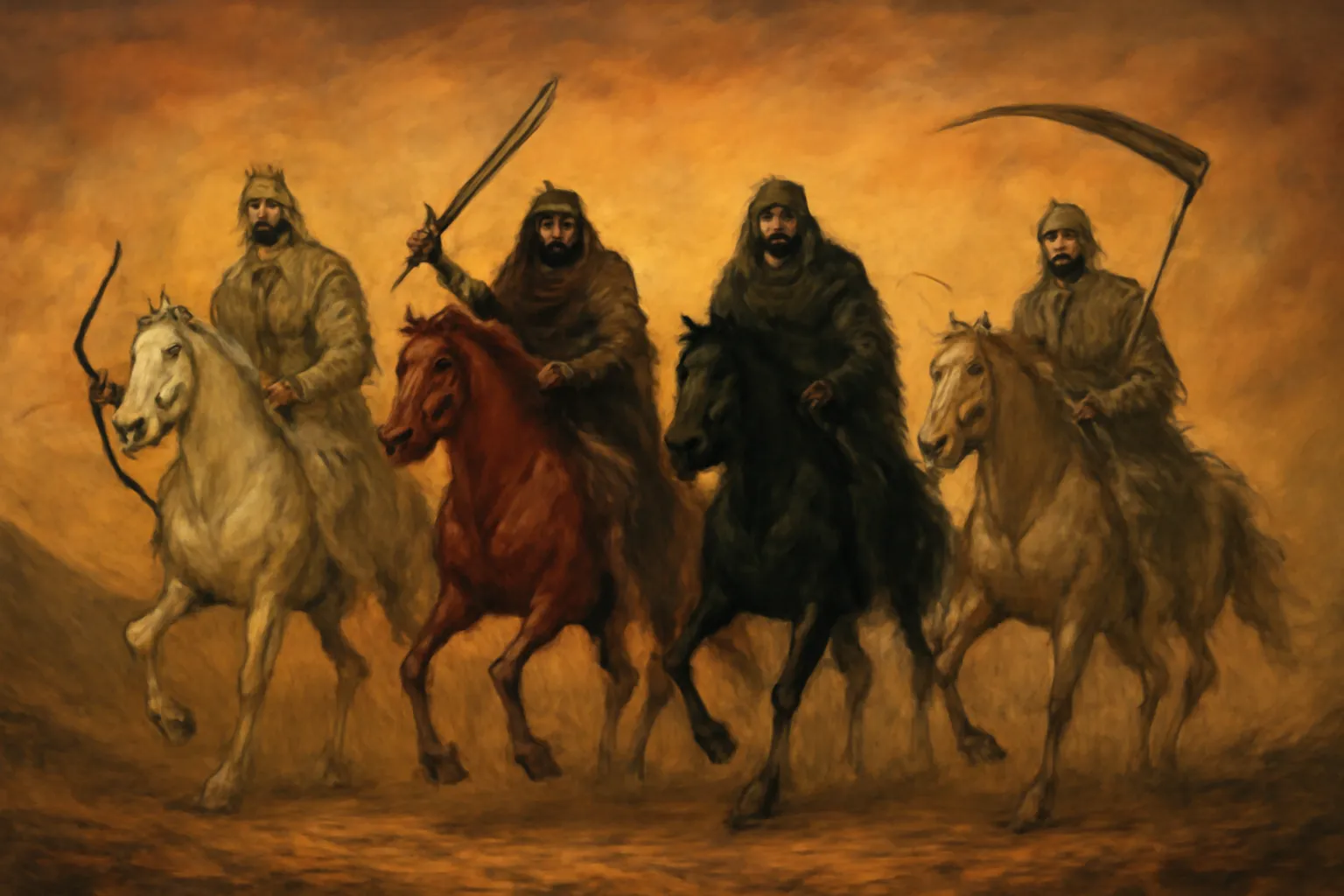
The first rider rides a white horse and carries a bow. Classical readings typically interpret this figure as Conquest or Pestilence, depending on the emphasis of the tradition.
Conquest interpretation: The white horse stands for political or cultural domination, often linked to the spread of empires and the assertion of power. In some readings, the rider’s crown signals legitimate rule or the appearance of authority and victory, though the context invites scrutiny about the means by which conquest is achieved.
Pestilence interpretation: Others see the rider as a sign of infectious disease or other plagues that accompany societal upheaval. In this view, the white horse points to invisible forces shaping human history—sickness, contagion, and the fragility of life under crisis.
Different communities have emphasized different dimensions based on historical context. For example, during eras of imperial power, Conquest has often taken precedence; in times of epidemic, Pestilence has been foregrounded. Regardless, the White Horse signals a disruptive force that mobilizes human societies toward uncertain futures.
The second rider is on a red horse, wielding a large sword. This rider is almost universally associated with War, bloodshed, and the tearing apart of social order.
War interpretation: The red horse embodies violent conflict, the breakdown of peace, and the coercive power of armed conflict. The rider’s sword evokes the deadly tools of war and the violence that accompanies political and military struggle.
Some readers also consider civil strife and revolution as manifestations of the red horse, especially when political factions turn against one another in brutal fashion.
The Red Horse thus functions as a stark reminder that human societies are susceptible to organized violence and that war often multiplies human suffering and destabilizes economies, communities, and institutions.
The Black Horse: Famine and Economic Imbalance
The third rider rides a black horse and carries a pair of scales. This imagery most commonly symbolizes Famine and economic disparity, including concerns about scarcity and the ethics of distribution.
Famine interpretation: The scales emphasize measurement of rations and the precarious balance between supply and demand. It points to periods when food becomes scarce, prices rise, and vulnerable populations suffer.
Economic inequality interpretation: Some readings highlight how scarcity often compounds social injustice, with the powerful controlling resources while the weak bear the burden. The rider’s presence underscores the moral questions surrounding resource stewardship in times of crisis.
The Black Horse teaches a sober lesson about the fragility of human needs and the ways in which economic systems can exacerbate inequality under pressure.
The Pale Horse: Death and its Domain
The final rider appears on a Pale (often described as pale-green) horse and is followed by Death, with Hell following after him. This rider is widely interpreted as Death in its broadest sense—cessation of life due to violence, famine, disease, and other causes.
Death interpretation: The Pale Horse personifies mortality as an inevitable companion of human history, underscoring the universality of death that transcends borders, cultures, and systems of life.
Some traditions pair Death with Hades or the afterlife, emphasizing theological themes about judgment, the ultimate fate of souls, and the sovereignty of God over life and death.
The pairing of Death with the Pale Horse is a stark reminder that, in the classical arc of Revelation, even the most powerful humans and institutions are subject to forces beyond their control. The sequence culminates in a cascade of calamities that culminate in a climactic judgment, depending on the interpretive lens being used.
Signs, Timelines, and End-Times Readings
Readers have long asked: do the Four Horsemen predict a chronological sequence of events leading to the end times? The answer depends on the interpretive framework, but several common motifs recur across traditions:
Premonitory signs: The appearance of the first seal (the White Horse) is often treated as the initial sign that something major is underway. Subsequent riders amplify the sense of crisis—war, famine, and death escalate the upheaval that heralds final judgment.
Sequential or symbolic timing: Some readers view the horses as a literal timetable of events; others see them as symbolic indicators of recurring patterns of turmoil that recur in varied forms across history.
Judgment and mercy: In many theological readings, the horsemen serve a dual purpose: they reveal the consequences of human choices and demonstrate God’s sovereignty in guiding history toward ultimate justice and restoration.
Various Christian traditions translate these signs into different eschatological expectations. Here are a few broad categories that reflect different emphases:
Futurist readings: Emphasize a forthcoming sequence of events that culminates in a final crisis and a visible intervention by God in the last days.
Preterist readings: Understand much of Revelation as fulfilled in the first centuries, with the horsemen representing forces active in the Roman world or other historical pressures of that era.
Historicist readings: See Revelation as a panorama of church history, with the horsemen representing ongoing movements through the centuries.
Idealist readings: Treat the horsemen as timeless archetypes of spiritual realities—war, famine, death, and conquest as ongoing human conditions—rather than fixed events.
Despite the methodological differences, most explanations acknowledge that the signs of the end are not merely about external calamities. They often have a moral dimension, inviting readers to respond with faith, repentance, and ethical action in the face of suffering.
Theological Perspectives and Interpretive Frameworks
The Four Horsemen Revelation has invited a spectrum of interpretive frameworks within Christian theology. Here are some of the principal schools of thought and how they approach the rider imagery:
Preterist Perspective
In a preterist approach, Revelation’s prophecies are primarily understood as events that occurred in the distant past, especially during the first century CE. From this vantage point, the horsemen may symbolize political, social, and military forces operating within the Roman world and the broader imperial system. The focus is on how early Christians understood suffering under empire and how their expectations of divine justice were formed in that historical context.
Futurist Perspective
In a futurist reading, the horsemen are interpreted as future events that have not yet occurred. This framework often places the Four Horsemen within a larger eschatological sequence that includes the Tribulation, the Antichrist, and the ultimate return of Christ. Advocates emphasize a chronological unfolding of judgments, with the horsemen acting as precursors to a climactic intervention by divine power.
Historicist Perspective
For a historicist view, Revelation maps onto the entire sweep of church history—from the apostolic era to the eschaton. The four horsemen, in this reading, symbolize recurring episodes across centuries: wars that rearrange political orders, famines that devastate economies, and the inexorable approach of death as humanity faces mortality on a grand scale. This framework highlights the continuity of suffering and the persistence of divine sovereignty through time.
In an idealistic or symbolic approach, the horsemen are not tied to specific historical events but to universal spiritual truths. They represent ongoing human conditions—ambition, violence, scarcity, and mortality—that recur in every age. The idealist reading emphasizes moral and spiritual lessons: the need for humility, compassion, and steadfast faith amid upheaval.
Other Theological Nuances
Beyond these mainstream categories, theologians discuss the moral economy of Revelation—how divine justice is imagined to work, what constitutes true leadership in times of crisis, and how communities are called to respond to impending judgments. Some readers stress the role of intercession, mercy, and restoration, reframing the horsemen not merely as agents of doom but as signals that invite repentance and renewal.
Cultural, Artistic, and Literary Impact
The potent imagery of the Four Horsemen has transcended theology to become a pervasive motif in culture. In art, literature, film, and music, the horsemen appear as archetypes of global crisis and moral choice. They have been reinterpreted in countless ways—sometimes as literal figures of judgment, other times as metaphorical representations of societal pressures.
Artistic Representations
From medieval altarpieces to modern digital art, artists have used the four riders to convey themes of conquest, conflict, scarcity, and mortality. The palette of horse colors—white, red, black, and pale—has provided a visual shorthand for readers and viewers to grasp the intensity of impending upheaval. In some works, the riders are styled as ominous surrogates of political powers; in others, they become universal emblems of human vulnerability.
Literary and Cinematic Echoes
Across centuries, novelists and screenwriters have borrowed the horsemen to build narratives about armageddon, end-time prophecy, and existential risk. In fiction, the horsemen often function as catalysts that force protagonists to confront moral questions: What does it mean to respond with courage, mercy, or faith when civilizations shake apart?
Contemporary Discourse
In modern discourse, the Four Horsemen can be invoked in debates about climate change, global conflict, economic instability, and public health. Some commentators use the imagery to underscore the urgency of addressing systemic vulnerabilities; others caution against sensationalism, urging careful interpretation that respects religious contexts and avoids deterministic predictions.
Modern Relevance: End Times Discourse in Contemporary Life
Even in secular spaces, the symbolism of the Four Horsemen resonates as a mnemonic for contemplating risk, resilience, and ethical response. Here are a few dimensions of contemporary relevance:
Global risks: Contemporary forces such as armed conflict, pandemics, climate-related disruptions, and economic shocks can echo the broad categories of conquest, war, famine, and death. The imagery provides a language for discussing existential threats and collective responsibilities.
Ethical reflection: The horsemen underscore the moral dimensions of crisis—questions about leadership, justice, mercy, and the distribution of resources during emergencies.
Resilience and hope: For many readers, Revelation’s ending offers a counterpoint to despair: even amid dire signs, there is a call to hope, repentance, and the possibility of transformation and renewal.
In congregational life and religious education, the Four Horsemen can be used as a framework for exploring how communities respond to crisis. They invite discussions about preparedness, solidarity, and spiritual disciplines that sustain people when resources are strained or when violence and disease disrupt everyday life.
Common Misconceptions and Clarifications
Because the Four Horsemen Revelation is widely discussed, several misconceptions persist. Clarifying these points helps readers engage more accurately with the text and with scholarly discourse:
Literal interpretation is not universal: Not all readers understand the horsemen as literal, chronological events. Many traditions treat the imagery as symbolic or allegorical, inviting morally or spiritually focused reflections rather than precise predictions.
Colors do not map one-to-one with modern categories: The horse colors (white, red, black, pale) symbolize particular types of crisis, not necessarily modern equivalents of fashion or fashion color.
Multiple legitimate readings exist: The value of the Four Horsemen lies in the conversation they spark among diverse communities. A single, exclusive interpretation is uncommon, and cross-disciplinary approaches provide richer understanding.
End times themes can be challenging but purposeful: For many readers, eschatological language prompts ethical action and spiritual formation, rather than fear or fatalism.
Practical Reflections: What the Four Horsemen Teach Today
While the imagery belongs to a particular ancient text, its themes offer practical insights for contemporary life. The following reflections focus on how readers might apply the lessons of the Four Horsemen to personal and communal conduct:
Embrace preparedness without panic: The appearance of crisis bodies forth a demand for prudent planning, social responsibility, and equitable care for the vulnerable.
Cultivate resilience: Economic and health shocks remind communities to develop robust systems of support—food security, healthcare access, disaster response, and social safety nets.
Foster ethical leadership: Crises reveal leadership qualities. The horsemen encourage transparent, compassionate, and accountable leadership that prioritizes the common good.
Practice mercy and solidarity: In times of fear and scarcity, generosity and solidarity become powerful counterweights to the forces symbolized by the riders.
Engage the spiritual dimension: For many believers, the Four Horsemen prompt prayer, contemplation, and ethical discernment—seeking meaning and hope amid suffering.
These practical takeaways show that even ancient symbols can be used to inform modern ethics, public policy discussions, and personal growth, without resorting to sensationalism or fatalism.
Reading the Four Horsemen with Care and Context
The Four Horsemen Revelation remains a rich, contested, and profoundly influential part of biblical literature. By examining the four horsemen in their historical context, considering the range of interpretive frameworks, and reflecting on their cultural impact, readers can gain a deeper appreciation for how symbols operate across time. Whether interpreted as Conquest, War, Famine, and Death, or understood as timeless archetypes of human experience, the horsemen invite ongoing dialogue about justice, suffering, and hope. In the end, the power of this imagery lies less in pinning down a single prophecy and more in engaging communities in thoughtful reflection about how to live with courage, compassion, and faith in the face of crises that humanity inevitably faces.
For readers seeking to explore further, consider consulting commentaries that span the spectrum of interpretive approaches, as well as historical studies that illuminate the cultural world of the first-century Mediterranean basin. The discussion of the Four Horsemen is not merely an education in interpretation; it is an invitation to examine our own time, our responsibilities to others, and our hopes for a more just and compassionate world.
Bible Revelation Timeline — A Clear Guide to the End Times The final book of the Bible, often referred to as the Book of Revelation, presents a sweeping view of the end times and the ultimate victory of God. Because it uses vivid apocalyptic imagery and symbolic numbers, readers have long sought a coherent eschatology…
Introduction to the Fourth Horseman Revelation The Fourth Horseman of the Apocalypse, often called the fourth rider, is one of the most discussed figures in eschatology and end times prophecy. In the biblical narrative found in the Book of Revelation, this rider is linked with the pale or ashen horse and is associated with Death…