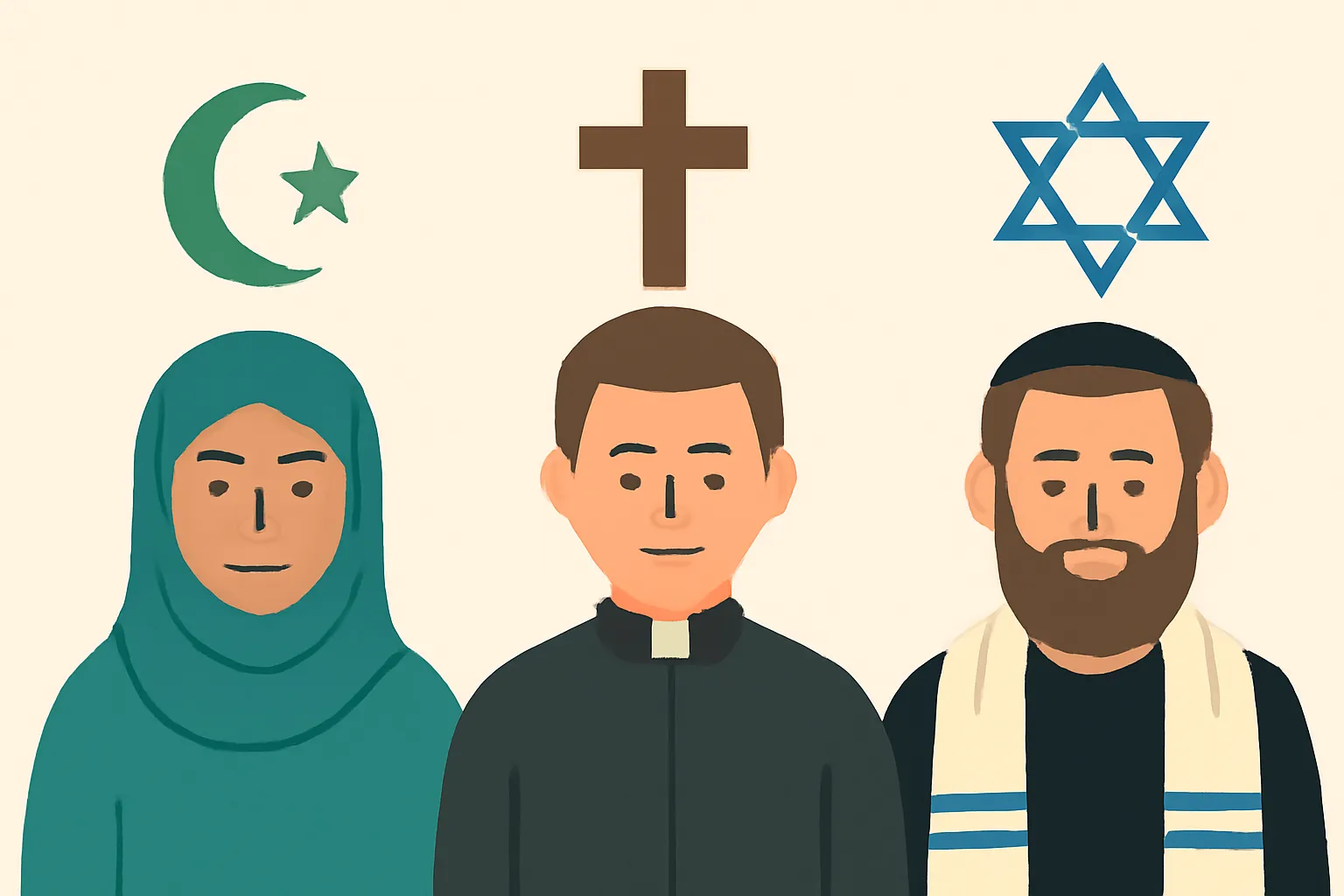
Muslim Christian Jew is a phrase that signals more than a simple listing of faith communities. It points to a shared human project: to understand one another, to seek truth with integrity, and to work toward a just and peaceful coexistence. In this article, we embark on a journey through the worlds of Islam, Christianity, and Judaism, tracing how these three traditions emerged from common roots, how they diverged, and how they sometimes converged in history. The aim is not mere comparison but a careful examination of how interfaith dialogue can be nourished by knowledge, empathy, and concrete acts of cooperation.
Foundations: The Shared Roots of Islam, Christianity, and Judaism
The terms Muslim, Christian, and Jew designate adherents of distinct faith communities, yet they also name people who often share a monotheistic heritage, sacred scriptures, and a lineage of prophets. The Abrahamic family of traditions places Abraham at an ancestral crossroads, creating a symbolic and theological framework that invites dialogue even as it celebrates diversity. When we speak about interfaith engagement, we are engaging with centuries of interpretation, practice, and community life that reflect both overlap and divergence.
Key concepts that unite these faiths include a belief in a single, sovereign God, a reverence for revelation, and a call to moral responsibility. The monotheistic sense central to Islam, Christianity, and Judaism provides a common vocabulary for discussing ethics, justice, mercy, and how to treat the vulnerable. Yet each tradition also emphasizes different centers of gravity: for Muslims, the Qur’an and the Prophet Muhammad as the Seal of Prophets; for Christians, the life and message of Jesus and the apostolic witness; for Jews, the covenantal relationship with the God of Israel and the study of Torah. In studying these differences, it is essential to honor each tradition’s own integrity while remaining open to the shared wisdom they offer.
In practical terms, the three faiths share a reverence for sacred history, moral guidance, and communal worship in space and time. They also share a complex relationship with prophets, angels, and divine guidance as recorded in their sacred texts. The task of interfaith education is to illuminate these connections without flattening the distinct theological claims that believers hold dear. A balanced approach acknowledges both continuity and difference as legitimate aspects of spiritual life.
Historical Intersections: Early Encounters and Intellectual Exchange
Across the centuries, Muslims, Christians, and Jews have met in cities of learning, commerce, and faith. Those encounters ranged from collaboration and translation to conflict and exile. A nuanced reading of history reveals how these communities sometimes learned from one another even while maintaining theological boundaries. Understanding this history helps contemporary readers approach interreligious dialogue with a sense of realism and hope.
Early Encounters in the Middle East and North Africa
In the first centuries after the rise of Islam, large communities of Jews and Christians lived under Islamic rule, enjoying periods of relative tolerance and patronage. Scholars in cities like Cordoba and Baghdad contributed to a vibrant intellectual milieu where Jewish, Christian, and Muslim scholars translated and debated philosophical, scientific, and theological texts. This era produced shared languages of learning—Arabic as a lingua franca of scholarship, and a common interest in understanding Greek philosophy through an Islamic lens. Interfaith collaboration and mutual influence were not rare but part of everyday life in certain epochs.
Medieval Bridges: Philosophy, Science, and Religious Polemics
During the medieval period, Islamic scholars preserved and expanded upon much of the philosophical heritage of late antiquity and early Byzantium, often translating and commenting upon works that were also central to Christian and Jewish scholars. In places such as Toledo, translation projects brought together Muslim, Christian, and Jewish scholars who engaged with questions of logic, ethics, and interpretation of scripture. These exchanges sometimes laid the groundwork for shared ethical frameworks, even as doctrinal debates continued. It is important to note that dialogue did not erase conflict; rather, it demonstrated that peaceful coexistence and intellectual curiosity could coexist with disagreement.
Theological Common Ground and Distinctives
What unites and differentiates the three faiths is not incidental detail but a living conversation about God, law, virtue, and human destiny. A careful study of similarities can foster humility and curiosity, while respectful attention to differences clarifies what each tradition uniquely cherishes. The following sections outline some core areas of overlap and divergence that commonly shape Muslim-Christian-Jewish conversations.
Monotheism, Revelation, and the Prophetic Tradition
All three faiths profess belief in a single, sovereign God who reveals divine will to humanity. The language of revelation—whether through the Qur’an, the Bible, or the Hebrew Bible—speaks to a shared conviction that God communicates with people across time. The figure of the prophet serves as a bridge in these conversations: the Prophet Muhammad in Islam, Jesus in Christian faith (as the Son of God and as a teacher and savior), and the prophets of Israel in Judaism. Each tradition interprets the role and significance of prophetic revelation through its own theological lens, but the underlying idea of a living, guiding relationship with God remains a central point of connection.
Sacred Texts, Law, and Ethical Life
The three traditions produce a rich corpus of sacred literature that guides worship, ritual practice, and daily conduct. The Qur’an speaks to faith, justice, mercy, and community life; the Torah and related writings articulate covenantal obligations, ritual law, and moral duties; the Christian Bible (Old and New Testaments) presents a narrative of creation, fall, redemption, and the ethical implications of faith in God. While the legal frameworks of Islamic law (sharia) and Halakha in Judaism differ in approach and application, all three traditions place a high premium on charity (zakat/tsedakah/aid for the poor), justice, and care for the vulnerable. Dialogues often center on how these shared values can inform modern social and political life without erasing doctrinal integrity.
Religious Practice and Community Life
Worship patterns, sacred time, and communal identity reveal both common rhythms and distinctive expressions. Muslims gather for daily prayers in mosques, reflect during Ramadan, and celebrate Eid. Christians worship in churches, observe sacraments such as baptism and the Eucharist, and honor a liturgical year. Jews assemble in synagogues, keep Sabbath, and observe a calendar full of holy days such as Passover and Yom Kippur. In interfaith contexts, it is often helpful to explore the meaning of these practices—what they signify about devotion, identity, and relation to God—without reducing belief to ritual alone. Interfaith encounters can include joint service projects, shared educational programs, and cooperative worship experiences that honor each community’s dignity and autonomy.
Ethics, Justice, and the Common Good
A practical area of convergence across the Muslim, Christian, and Jewish worlds concerns ethics and social justice. Each tradition emphasizes the value of human dignity, care for the poor, and a call to repair the world. Exploring these shared commitments can yield tangible benefits for pluralistic societies and offer a framework for interfaith service that transcends doctrinal disagreement.
Human dignity as a foundational principle in public life and private conduct
Responsibilities toward the vulnerable–the poor, refugees, the elderly, the disabled
Advocacy for peace and the protection of life in all stages
Justice in economic systems, environmental stewardship, and responsible governance
These ethical commitments are not identical across traditions, but many shared concerns create a fertile ground for collaboration. In cooperative efforts—such as food drives, disaster relief, and education programs—Muslims, Christians, and Jews can model how faith communities translate belief into action, illustrating a lived practice of faith in which doctrine and deeds reinforce one another.
Challenges and Opportunities: Navigating Misunderstandings
Dialogue is not always easy. Historical memory, political conflict, and media narratives can create barriers to trust among Muslim communities, Christian congregations, and Jewish organizations. Yet many scholars and practitioners insist that genuine dialogue requires people to listen deeply, speak honestly, and acknowledge fear without capitulating to prejudice. Recognizing the sources of tension—misinformation, stereotype, power dynamics, and wounds from past injustices—can empower participants to address issues at their root rather than merely skimming the surface of disagreement.
Common Misconceptions to Challenge
“All three faiths are the same”—There are profound differences in belief, practice, and history, but there are also shared aspirations and ethical commitments that deserve attention.
“Interfaith dialogue is only for scholars”—Many effective conversations happen in classrooms, community centers, mosques, churches, synagogues, and online spaces with inclusive formats.
“Dialogue undermines faith”—Healthy dialogue can deepen conviction by testing beliefs in a respectful, truth-seeking environment.
Conversations about best practices for interfaith dialogue emphasize listening and learning, humility in the face of mystery, and a commitment to non-coercive exchanges. They also stress the importance of safeguarding religious autonomy while building shared projects that improve the common good.
Interfaith Dialogue in Practice: Models and Methods
Across the globe, communities adopt a variety of models to foster constructive exchange among Muslims, Christians, and Jews. These models range from formal programs in universities and religious centers to informal neighborhood initiatives that cultivate friendships and cooperation. The following examples illustrate the diversity of approaches to interfaith engagement.
Formal Programs and Institutional Partnerships
Interfaith study circles that examine sacred texts side by side with guided dialogue and reflective questions.
Joint educational programs in schools and universities that teach about the three traditions with emphasis on accuracy and sensitivity.
Collaborative social action initiatives—such as food banks, housing support, and refugee assistance—that bring diverse communities together around shared needs.
Community-Led Initiatives
Local councils and committees that include representatives from Muslim, Christian, and Jewish communities to address neighborhood concerns (e.g., safety, cultural events, interfaith praxes).
Dialogue evenings featuring guest speakers, Q&A sessions, and opportunities for open conversation in a non-pressurized setting.
Joint celebration of common holidays where feasible, acknowledging each tradition’s unique identity while recognizing shared values.
Dialogue through The Arts, Culture, and Service
Creative expressions and collaborative service projects can bridge divides by highlighting shared humanity. Music, art, theater, and storytelling provide powerful vehicles for communicating core beliefs in accessible, non-confrontational ways. Service projects—such as relief efforts after natural disasters or community education campaigns—demonstrate how faith communities can work side by side to alleviate suffering and promote human flourishing.
Practical Guidance: How to Foster Respectful Conversation
For individuals seeking to engage with Muslims, Christians, and Jews in a constructive manner, the following practical recommendations can help sustain respectful and fruitful dialogue:
Lead with listening: ask questions that show genuine curiosity about each tradition’s beliefs and practices, rather than prescribing beliefs about them.
Ground conversations in shared values such as dignity, justice, mercy, and compassion.
Acknowledge all sides’ trauma and fears—and work to build trust through consistent, small acts of goodwill.
Keep conversations civil and focused on ideas, not personal attacks, while naming and challenging harmful stereotypes when they arise.
Prioritize inclusive spaces that welcome families, youth, elders, and diverse voices within each tradition.
Develop clear goals for each encounter, whether it is education, service, or cultural exchange, and assess progress.
Follow up with concrete actions—joint events, shared statements on social issues, or cooperative community projects.
In practice, interfaith dialogue thrives when it is anchored in humility, rigorous study, and a willingness to translate theological concepts into everyday acts of neighborliness. The goal is not to erase differences but to recognize how differences can coexist with a shared commitment to the flourishing of all people.
Case Studies: Communities and Initiatives Worth Knowing
Around the world, notable initiatives model the potential of Muslim-Christian-Jewish collaboration. While no single model fits every community, these cases demonstrate how faith-based groups can work together to advance peace and mutual understanding.
The Abrahamic Family House concept—an architectural and social project in which a mosque, a church, and a synagogue are co-located to encourage joint programming, respectful dialogue, and visible solidarity among the three communities. This project embodies a practical form of cooperation that emphasizes coexistence and shared public life.
Interfaith dialogues in university settings that bring together students from different backgrounds to study ethics, political theory, and theology, paired with community service or volunteer work.
City and regional interfaith councils that convene monthly to address issues such as anti-Semitism, Islamophobia, Christian misrepresentations, and the protection of civil rights for all residents.
Global statements and local coalitions that arise in response to social justice concerns—protecting refugees, promoting freedom of conscience, and opposing violence in the name of religion.
These examples illustrate not only the possibilities of interfaith cooperation but also the practical realities—logistics, leadership dynamics, and the need for ongoing training in religious literacy and conflict resolution. They also remind us that meaningful dialogue is a process, not a one-off event, and often requires years of trust-building and shared effort.
Looking toward the future, the relationship among Muslim communities, Christian communities, and Jewish communities will likely be shaped by demographic shifts, technological changes, and evolving political landscapes. A constructive path forward emphasizes several key commitments:
Religious literacy as a foundational tool for preventing stereotypes and building mutual respect.
Inclusive leadership that ensures diverse voices within each tradition participate in decision-making and public discourse.
Public education that presents an accurate, nuanced picture of Islam, Christianity, and Judaism, including their histories of cooperation and disagreement.
Ethical public engagement where faith-based organizations contribute to the common good through acts of service, advocacy for human rights, and protection of vulnerable communities.
Continued exploration of theological commonality and respect for difference that allows each tradition to articulate its own beliefs faithfully while recognizing shared moral commitments.
In sum, the study of Muslim-Christian-Jewish life is not merely an academic exercise; it is a practical invitation to participate in a global conversation about how faith can inform civic life, how communities can protect each other, and how people can live with courage and compassion in a diverse world. The path requires patience, courage, and the disciplined pursuit of truth-telling and empathy. When these elements are in place, interfaith dialogue can become a powerful engine for peace, justice, and human flourishing for all people who claim these venerable religious identities.
Across continents and centuries, the relationship between Islam and Christianity has shaped civilizations, inspired scholars, and challenged communities to think anew about faith, justice, and shared humanity. This article explores the topic often described as the Muslim–Christian religious landscape, examining core beliefs, historical interactions, and ongoing efforts at interfaith dialogue. By treating this subject as…